The Core Thesis
The argument begins with a deceptively simple observation: cat purring operates at 25–50 Hz, extending to 140 Hz. This range is biologically non-arbitrary. Research has shown it promotes bone density and tissue healing, overlaps with frequencies used in therapeutic ultrasound for tissue repair, and entrains low-beta to alpha brainwave states. A person being kneaded by a purring cat is not just receiving acoustic stimulation — they are being vibrated at a therapeutically relevant frequency through direct mechanotransduction, while bilateral rhythmic pressure on the solar plexus region activates the celiac plexus, the largest autonomic nerve cluster outside the brain.
The cat unintentionally delivers a multimodal therapeutic intervention. This is the anchor for everything that follows.
40 Hz Specifically
40 Hz sits at the lower boundary of the gamma brainwave range (30–100 Hz) and has accumulated a specific and unusually robust research profile.
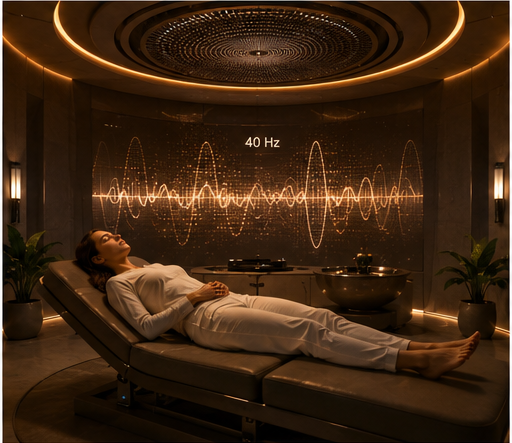
- Neural binding: Gamma oscillations are associated with high-level cognitive integration, attention, and memory consolidation. 40 Hz is where the binding function peaks.
- Alzheimer's research: MIT/Picower Institute research (Iaccarino et al., 2016) showed that 40 Hz light and sound flicker dramatically reduced amyloid plaques and tau tangles in mouse models. The findings have since entered human clinical trials.
- Binaural construction: When 440 Hz is played in one ear and 400 Hz in the other, the brain constructs a phantom 40 Hz oscillation. This entrainment has measurable EEG effects and does not require the 40 Hz sound to exist in the physical environment.
- Monastic observation: Tibetan Buddhist monks in deep meditative states spontaneously produce gamma-range neural synchrony. This is measured, not inferred.
Jazz Musicians as Unwitting Longitudinal Study
The most striking evidence for vibroacoustic longevity effects does not come from controlled trials — it comes from an inadvertent natural experiment running for sixty years across hundreds of subjects.
Jazz musicians who sustain ensemble improvisation careers into advanced age show unusual patterns of healthy longevity. Ahmad Jamal (1930–2023, age 92), Wayne Shorter (1933–2023, age 89), Herbie Hancock (b. 1940, active at 85+), Ron Carter (b. 1937, active at 88+), Sonny Rollins (b. 1930, alive at 95+). These are not outliers — they are the norm for musicians who maintain active ensemble improvisation across decades.
The mechanism has at least three components. First: sustained daily vibroacoustic exposure. A jazz bassist with hands in continuous contact with a vibrating instrument in the 30–120 Hz range for sixty years is receiving daily vibroacoustic therapy. A saxophonist has the instrument vibrating against lips, face, and chest — the air column producing standing waves the player inhabits. Second: ensemble improvisation demands real-time gamma-range neural coherence across distributed brain regions, with hyperscanning studies showing EEG coupling between musicians. Third: social embeddedness — longevity research consistently identifies strong social connection as among the most powerful predictors of healthy aging, and ensemble jazz embeds practitioners in precisely this structure.
The medicine was never designed. It was simply played.
World Healing Traditions and Their Frequencies
The research mapped twelve-plus healing traditions to their acoustic mechanisms. What emerges from this survey is not cultural relativism but a striking physical convergence: traditions separated by thousands of years and thousands of miles independently converged on two shared physical territories.
- Low-frequency drone (40–150 Hz): Tibetan singing bowls, throat singing (Gyuto monks), didgeridoo, the bass register of Indian classical music, Gregorian chant's resonant low tones, the bodhrán and frame drum's fundamental. The vibroacoustic tissue-medicine band.
- Rhythmic pulse at 3–7 Hz: Shamanic drumming (Siberian, Native American), the tala rhythm structures of Indian classical performance, the repetitive rhythmic patterns of Shipibo icaros. The theta entrainment band — trance, trauma access, the healing state.
The didgeridoo deserves specific mention. It may be the single most potent instrument in this framework. Its frequency profile (60–100 Hz fundamental) covers the entire therapeutic window, circular breathing creates continuous vibration with no interruption, and it is the only traditional instrument with a published randomized controlled trial demonstrating specific clinical effects — Puhan et al. (2006, BMJ) showed it significantly reduces sleep apnea severity.