GripSuit
Four biological adhesion systems — gecko, clingfish, remora, and mussel — integrated into a single wearable platform. Glass. Concrete. Rock. Submerged steel. No suction pump. No glue. No mechanical fastener. Reversible on demand.


From Gecko to Remora — Synthesis, Characterization, and Cycle-Fatigue Testing of a Four-Mechanism Biomimetic Adhesion Stack at Human Body-Weight Scale. Four research threads, full IP framework, path from TRL 3 to TRL 6. Submitted to an advanced polymer research lab.
Climbing technology hit a wall — and stayed there.
Conventional climbing hardware — cams, nuts, bolts, suction cups — has reached diminishing returns. Suction cups fail on rough or wet surfaces. Magnets only work on ferrous substrates. The gecko solved this 200 million years ago with geometry, not chemistry. The ceiling wasn't in the physics. It was in the fabrication. That fabrication path now exists.
Van der Waals adhesion requires pillar tips within 5–10 nm of substrate. Surface asperities above pillar height mechanically exclude tips from contact, reducing effective area to near zero on rough concrete (Ra >100 μm).
Nano-scale tips adhere readily to dust particles (5–50 μm). Particulates coat the array surface, raising effective contact distance above the van der Waals range. All early demonstrations required freshly cleaned glass.
Water infiltration collapses dry vdW adhesion by replacing molecular contact with capillary-dominated mechanics. Real geckos maintain superhydrophobic setal surfaces through lipid secretions.
Producing sufficient force for a 90 kg climber requires large pad areas without area-scaling failures. Stiff pillars on stiff backing create stress concentrations that propagate delamination from pad edges inward.
Early PDMS and CNT pillar arrays lost adhesion rapidly with repeated cycles as pillars clumped, bent, or fractured. Operational longevity — thousands of load cycles — was never demonstrated at wearable scale.
Van der Waals adhesion requires a polarizable substrate. PTFE, paraffin wax, and pure hydrocarbon coatings present no molecular dipole. The gecko itself cannot adhere to Teflon. No mechanism in the GripSuit overcomes this.
Four biological systems. One integrated wearable.
Each adhesion layer addresses a distinct surface class and failure mode. The systems are designed to complement, not compete — with zone-selective pad architecture ensuring each mechanism operates only where it performs.
Hierarchical Nano-Pillar Array — Primary Adhesion (Gecko)
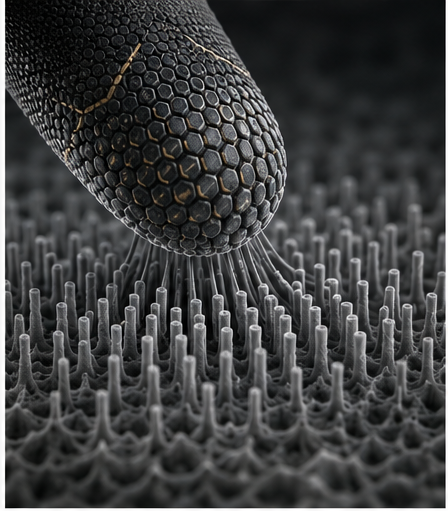
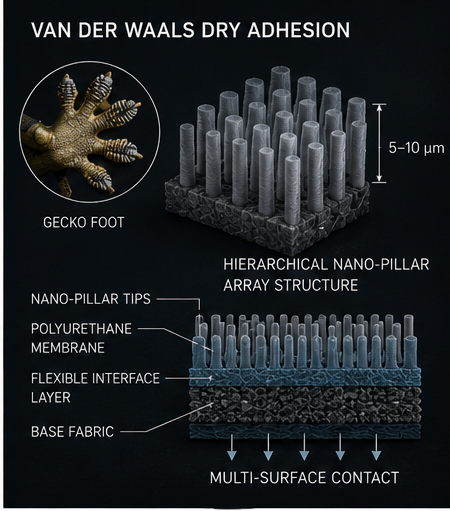
Polyurethane micro-pillars (5–10 μm height, 2–5 μm diameter) capped with 200 nm spatular tips at a density of approximately 10⁶ pillars/mm². The geometry replicates the tokay gecko's setal hierarchy: macro compliance allows the pad surface to conform to substrate waviness; the spatular caps make atomic-scale contact across the compliant area, engaging van der Waals forces across millions of simultaneous tip contacts.
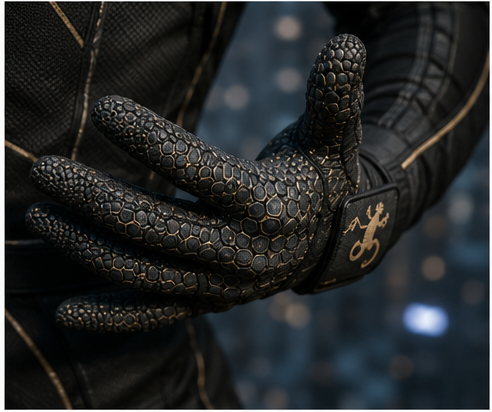
Validated adhesion: 10 N/cm² in shear on smooth, dry, polarizable surfaces — glass, painted steel, polished granite, most composites. DARPA's Z-Man program demonstrated full human body-weight loading (100 kg climber with 22 kg pack on 7.6 m vertical glass) using a precursor architecture in 2014. Detachment is directional: a wrist rotation perpendicular to the surface releases the array with negligible force. Biological model: Gekko gecko (Tokay gecko) · Autumn et al. 2000, 2002.
Clingfish Compliant Disc Lip — Rough Surface Conformability
The northern clingfish (Gobiesox maeandricus) adheres to barnacle-encrusted, algae-fouled intertidal rock with equal tenacity across a broad range of surface roughness — the exact regime where gecko vdW adhesion collapses. Its disc features a stiff central core surrounded by a compliant, flexible lip that deforms to seal around macro-scale aggregate geometry (Ra 100–800 μm). Hierarchical micro-filaments at the disc edge provide shear resistance by mechanically engaging surface asperities.
In the GripSuit, this mechanism translates to a Shore 20A silicone annular lip surrounding the central vdW pad zone in each palm and boot pad. On smooth glass the lip sits inert at the perimeter, adding negligible interference to vdW contact. On concrete or rock, the aggregate engages the lip, the micro-filaments bite into asperities, and the central vdW zone contributes whatever partial contact remains. The two mechanisms operate in parallel without conflict. Biological model: Gobiesox maeandricus · Wainwright et al. 2013; Ditsche & Summers 2014.
Remora Lamellar Spinule Array — Self-Tightening Under Shear
The remora evolved its adhesive disc specifically to grip rough shark skin while being dragged through water at speed. Its interior carries linear rows of tissue (lamellae) bearing tooth-like spinules oriented such that shear forces passively rotate the lamellae into greater contact — a Chinese finger trap geometry that self-tightens under the exact dynamic loading scenario a vertical climber generates when shifting weight laterally. A bioinspired 45g disc with 12 lamellae and 294 spinules withstood 27 N of force in published trials.
In the GripSuit, remora-style lamellae integrate into the inner face of the clingfish compliant lip — 6–9 lamellae per palm pad, PDMS lamellae with TPU spinule tips. The mechanism activates under shear load and relaxes for repositioning, with no mechanical actuation required. This is the primary load-bearing mechanism for the Aqua SKU on submerged surfaces. Biological model: Echeneis naucrates · Gamel et al. 2019; Wang et al. 2021.
DOPA-Mimetic Mussel Chemistry — Submerged Wet Bonding (Aqua SKU)
Mussels achieve 0.4 MPa bonding to wet rock, steel, and biological surfaces through 3,4-dihydroxy-L-phenylalanine (DOPA) — a modified amino acid that forms coordinate bonds with metal oxides and hydrogen bonds with virtually any hydroxyl-bearing surface, even fully submerged. DOPA-catechol chemistry at the tip of the byssal thread resists water displacement through a combination of covalent cross-linking and surface bridging unavailable to purely physical adhesion mechanisms.
In the GripSuit Aqua, a DOPA-mimetic polymer coating on the silicone disc lip surface augments the remora spinule mechanism in fully submerged conditions where both vdW and electrostatic augmentation are ineffective. No electronics, no PVDF harvesting, no power draw — entirely passive wet-chemistry bonding. This is the least-developed layer in the stack and the primary research target for the Aqua programme. Biological model: Mytilus edulis · Lee, Dellatore & Miller 2007; Waite & Tanzer 1981.
Electrostatic Adhesion Layer — Rough Surface Augmentation
Conductive electrode grids embedded within a dielectric elastomer substrate, energised at 1–3 kV by a body-motion PVDF harvester requiring no external battery. Electrostatic adhesion tolerates surface roughness up to approximately Ra 25 μm — extending the system's effective substrate range to rough concrete, unfinished stone, weathered brick, and coated metals — where vdW contact area collapses. Its role is augmentation, not replacement: activated automatically when surface-sensing identifies a roughness regime that degrades vdW contact. Electrical isolation from the silicone clingfish lip is required to prevent leakage through moisture on rough substrates — addressed in Apex pad packaging.
Dust Rejection and Pad Recovery System
A two-phase electrostatic cleaning circuit integrated into each pad zone. A square-wave voltage at 1–5 Hz drives charged contaminant particles through alternating repulsion and rolling-release, restoring greater than 80% of nominal adhesion after a cleaning cycle. Operates during pad repositioning — not during load bearing — drawing from the same PVDF network as the augmentation layer. Without this mechanism, concrete dust and skin oils progressively coat the pillar array, degrading adhesion 40–70% over a sustained climb.
What each GripSuit can climb — and what it cannot.
Surface compatibility varies by SKU because each carries a different adhesion stack. The three core mechanisms have partially conflicting pad geometries: a clingfish compliant lip sitting proud of the vdW pillar tips creates a standoff gap that destroys nano-pillar contact on glass. Purpose-built outperforms universal on every surface that matters to that SKU's owner.
| Surface | Ra | Scout vdW only |
Gloss vdW + ES |
Rough Clingfish + Remora |
Aqua Remora + DOPA |
Apex All systems |
Est. Adhesion (Apex) | TRL |
|---|---|---|---|---|---|---|---|---|
| Smooth glass (façade) | <0.1 μm | ✅ Primary | ✅ Primary | ⚠ Lip inert | ⚠ Reduced | ✅ Primary | 9–11 N/cm² | TRL 5 |
| Polished granite / marble | 0.1–0.4 μm | ✅ Primary | ✅ Primary | ⚠ Partial | ⚠ Reduced | ✅ Primary | 7–10 N/cm² | TRL 4 |
| Painted / powder-coated steel | 0.5–2 μm | ✅ Partial | ✅ Primary | ⚠ Partial | ⚠ Reduced | ✅ Primary | 6–9 N/cm² | TRL 4 |
| Bare structural steel | 2–8 μm | ⚠ Marginal | ⚡ ES assist | ⚡ Lip partial | ✅ Remora | ⚡ ES + lip | 4–7 N/cm² | TRL 3–4 |
| CFRP composite | 0.1–0.8 μm | ✅ Primary | ✅ Primary | ⚠ Partial | ⚠ Reduced | ✅ Primary | 7–10 N/cm² | TRL 4 |
| Rough cast concrete | 100–400 μm | ✗ Fails | ⚠ ES marginal | ✅ Primary | ✅ Remora | ✅ Lip + remora | 5–8 N/cm² | TRL 3 |
| Brick (un-mortared face) | 50–200 μm | ✗ Fails | ⚠ ES marginal | ✅ Primary | ✅ Remora | ✅ Lip + remora | 4–7 N/cm² | TRL 3 |
| Natural rock (climbing route) | 200–800 μm | ✗ Fails | ✗ Fails | ✅ Primary | ⚡ Partial | ✅ Lip + remora | 4–6 N/cm² | TRL 3 |
| Aircraft aluminium (anodized) | 0.3–1.5 μm | ⚠ Partial | ✅ Primary | ⚠ Partial | ⚠ Reduced | ✅ Primary | 6–8 N/cm² | TRL 3–4 |
| Submerged concrete / steel pier | 100–500 μm | ✗ Fails | ✗ Fails | ⚠ Reduced (wet) | ✅ Primary | ⚡ Aqua mode | 3–5 N/cm² | TRL 2–3 |
| Ship hull (biofouled steel) | 200–1000 μm | ✗ Fails | ✗ Fails | ✗ Fails | ✅ Primary | ⚡ Aqua mode | 2–4 N/cm² | TRL 2 |
| Wet glass / rain-covered façade | <0.1 μm | ⚠ Degraded | ⚡ ES assist | ⚠ Lip partial | ✅ DOPA assist | ⚡ Multi-mode | 3–5 N/cm² | TRL 3 |
| PTFE / Teflon-coated surfaces | <0.1 μm | ✗ Fails | ✗ Fails | ✗ Fails | ✗ Fails | ✗ Fails | ~0 N/cm² | — |
All adhesion figures per cm² of active pad contact area in shear direction. Operational load must account for total pad area deployed, safety factor ≥3.0, and dynamic loading from movement and wind. ✅ Primary mechanism at design target. ⚡ Augmented / reduced performance. ⚠ Marginal / pending validation. ✗ Known physical limit.
How much surface the wind demands.
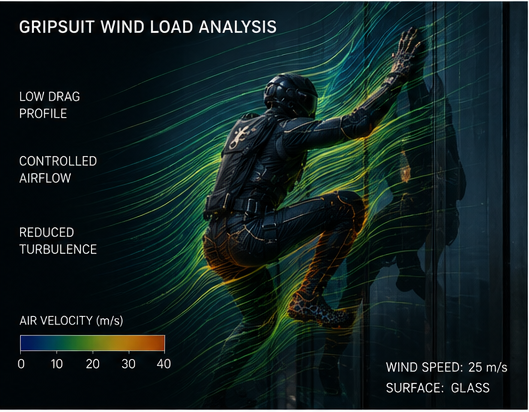
A climber on a vertical surface faces wind as a direct peel force — perpendicular pull-away, the worst-case loading geometry for a Van der Waals adhesive. Aerodynamic drag F = ½ · ρ · Cd · A · v². For a climber flattened against a vertical surface: frontal area A ≈ 0.6 m², Cd ≈ 1.1, ρ = 1.225 kg/m³, total mass 110 kg (full loadout).
Urban high-rise turbulent gust — common condition above 50 m. Direction unpredictable. Peel force manageable within active pad area; gust-load factor should be applied at detailed design stage.
Five purpose-built SKUs. Four surface classes.
The GripSuit line segments by surface environment rather than price tier alone. Purpose-built outperforms universal because the three core mechanisms have conflicting pad geometry requirements — you cannot optimize glass and concrete contact in the same pad zone simultaneously. Each SKU carries the stack optimized for its environment.
| SKU | Est. Price | Biological Models | Mechanism | Primary Literature |
|---|---|---|---|---|
| Scout / Gloss / Apex core | $349–$65K | Tokay gecko (Gekko gecko) | Hierarchical setal vdW dry adhesion — 200 nm spatular tips, ~10⁶/mm² | Autumn et al. 2000, 2002; DARPA Z-Man 2014 |
| Rough / Apex lip | $6K–$65K | Northern clingfish (Gobiesox maeandricus) | Compliant disc lip; hierarchical micro-filaments for shear on asperities Ra 0.1–800 μm; works wet and dry | Wainwright et al. 2013; Ditsche & Summers 2014 |
| Rough / Aqua / Apex lamellae | $6K–$65K | Remora (Echeneis naucrates) | Lamellar spinules self-tighten under shear load; 27 N validated on 45 g bioinspired disc | Gamel et al. 2019; Wang et al. 2021 |
| Aqua / Apex wet mode | $28K–$65K | Mussel (Mytilus edulis) | DOPA-mimetic catechol surface chemistry — coordinate bonds + H-bonds on wet metal oxide and hydroxyl surfaces | Lee, Dellatore & Miller 2007; Waite & Tanzer 1981 |
Price, performance, and surface range are design targets based on current TRL and published literature for component technologies. Wind ratings reflect pad-area-limited operational guidelines at SF 3.0. Physical prototyping and environmental testing required before commercial release.
Research Status — Not For Individual Construction
The GripSuit is an active research platform at TRL 2–5 across its component systems. The technology described on this page is grounded in published materials science and validated biological mechanisms, but has not yet been integrated, tested at full human body weight across all documented surface classes, or subjected to the iterative failure-mode analysis that separates a research direction from a deployable product.
A person who constructs a climbing system based on the concepts described here without following a rigorous iterative development and testing protocol — including progressive load testing, failure mode enumeration, and controlled environmental testing — is placing themselves in serious physical danger. Dry adhesive systems can fail rapidly and without warning when contamination, surface chemistry, or loading geometry deviates from validated conditions.
We publish this research to advance the field and attract the technical and capital partners capable of pursuing it correctly. We do not publish it as a construction guide.
The adhesion platform extends beyond climbing.
The surface science validated in GripSuit seeds directly into three adjacent programmes already in development.
DragonSuit — Shared Surface Science
The shark-denticle riblet surface film validated in the DragonSuit directly co-locates with the GripSuit's pad backing substrate. Hybrid wearables — high-performance aerodynamic surfaces with embedded grip pads at load-bearing contact points — represent the next integration milestone.
Explore DragonSuit →AquaSuit — Underwater Adhesion
The GripSuit Aqua's DOPA-mimetic mussel chemistry and remora disc architecture seed directly into the AquaSuit programme's surface adhesion work for underwater structure access and marine robotics applications.
Explore AquaSuit →Industrial Robotics — Non-Wearable
The nano-pillar array and self-cleaning circuit are directly applicable to robotic end-effectors for handling smooth substrates — glass panels in construction automation, composite skins in aerospace assembly, silicon wafers in semiconductor handling.
Discuss licensing →Documentation.
Contact: getdragons@dragonworx.bio · Richardson, Texas