There is a version of this observation that applies to almost every technology in the human movement space: the athlete improved, and the equipment quietly stopped improving around them. In wingsuit flying, the glide ratio ceiling got papered over by better pilots squeezing more out of progressively marginal suit iterations. In climbing, the equivalent dynamic played out over roughly the same period — and the concealment mechanism was even more effective, because the sport's culture celebrates the human body as the primary instrument. When Alex Honnold free-soloed El Capitan, the story was correctly about Honnold. The shoes he wore got a sentence, maybe two.
But the shoes represent a genuine materials ceiling, and so do the pads, and so does every suction-based access system that preceded them. Understanding where that ceiling sits — and what it's actually made of — turns out to be the prerequisite for building something genuinely different.
The Physics of Staying Put
Adhesion, in the engineering sense, comes in a small number of flavours. You can press something against a surface with enough normal force that friction does the work — this is what climbing shoes do on rock. You can create a pressure differential between the adhesive and the ambient air, so that atmospheric pressure pushes the adhering surface against the substrate — this is what suction cups do. You can use chemical bonding — glues, resins, epoxies — to create covalent or ionic connections between surfaces. Or you can use magnetic attraction on ferrous substrates.
Each of these mechanisms has been understood for well over a century. Each has been refined to a reasonable approximation of its theoretical maximum in some product category or another. And each carries hard physical constraints that more engineering iteration cannot dissolve.
Friction adhesion scales with normal force and surface roughness. At the loads a human body generates, it works on rough rock at steep angles, and it fails — or requires exhausting muscular effort — on smooth vertical surfaces of any kind. The limit isn't the shoe material. It's the coefficient of friction between rubber and glass, which is a material constant, not a design parameter.
Suction adhesion requires a pressure seal. The seal requires surface conformity at the macroscale — the cup rim must mate continuously with the substrate. Any surface irregularity, any dust particle under the rim, any moisture that permits a leak path, and the differential pressure collapses. A smooth, clean, dry glass wall is an excellent suction surface. A concrete column, a brick face, a weathered granite slab — these are not. The mechanism simply doesn't have a failure mode that gracefully accommodates what real surfaces actually look like.
And magnetic adhesion — effective as it is on structural steel — is irrelevant on everything else. Glass curtain-wall towers. Concrete. Limestone. Carbon fibre. The entire built and natural vertical world that isn't a steel plate is outside the magnetic mechanism's operating envelope.
So where does that leave us? With a fairly complete map of what the existing tools cannot do. Which is, as it turns out, a useful place to start.
✦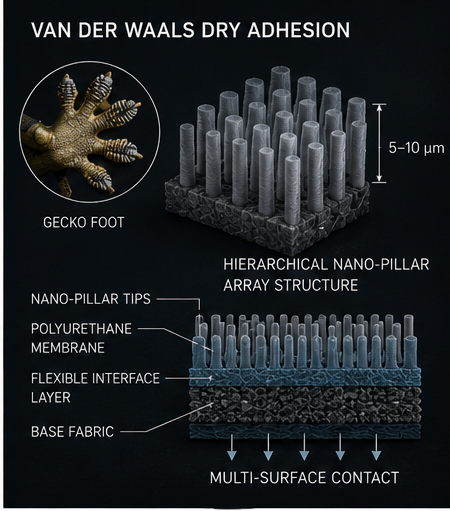
The GripSuit adhesion stack: nano-pillar tips → polyurethane membrane → flexible interface → base fabric. Each layer solves a distinct physics problem. The gecko foot has been solving all four simultaneously for 200 million years.
What the Gecko Was Doing While We Were Perfecting Suction Cups
The Tokay gecko — Gekko gecko, a large aggressive species of southeast Asia with the approximate temperament of a small territorial dog — can run across a glass ceiling at speed, hang from a single toe, and transfer from one surface to an entirely different one in a fraction of a second. It does this using no suction, no glue, no friction in the conventional sense, and no mechanism that requires the surface to be anything other than polarizable at the molecular level.
For most of the twentieth century, scientists assumed there must be suction involved, or some kind of micro-secreted adhesive. Dissection of the toe pads found no glands. Vacuum experiments found no reduction in adhesion. By the 1990s the leading hypothesis had shifted to van der Waals forces — the weak intermolecular attraction that acts between any two surfaces in close enough proximity — but nobody had a way to test it directly at the scale of a single seta.
In 2002, a team at Berkeley, Stanford, and Lewis & Clark College ran the definitive experiment. Using MEMS cantilever force sensors, they measured the adhesive force of a single isolated gecko seta on hydrophobic and hydrophilic semiconductor surfaces. The result settled the question: van der Waals forces, operating across the 500 million spatular tips of a single gecko foot, generate enough cumulative atomic-scale attraction to support a 350-gram lizard running upside-down on glass. No chemicals. No pressure differential. No magnetism. Just geometry, at a scale and density that had been beyond any human fabrication process to replicate.
"The remarkable adhesive properties of gecko setae are merely a result of the size and shape of the tips — not strongly affected by surface chemistry."
— Autumn et al., PNAS, 2002
"Merely." As if that were a trivial observation. What the sentence actually says is that the entire mechanism is geometric, not chemical — which means it's a fabrication problem, not a materials-discovery problem. You don't need a new substance. You need a new shape, at a new scale, produced at sufficient density and compliance to make atomic contact with whatever surface presents itself.
That is a very different kind of problem. And in 2002, it was still an unsolved one.
Twenty Years of Almost
What followed the 2002 paper was two decades of research that produced impressive demonstrations and a consistent set of failure modes. The gecko adhesion field became one of the more active corners of biomimetics, and the list of groups that built working prototypes — Stanford, MIT, Carnegie Mellon, Draper Laboratory, assorted European and Chinese university programs — is long. DARPA funded a program. A climber ascended 7.6 metres of vertical glass using gecko-inspired pads. Carbon nanotube arrays demonstrated adhesion more than ten times stronger than the gecko's own foot at small scales.
And then, reliably, the wall appeared.
The Four Failure Modes That Stopped Everyone
Rough surfaces. Van der Waals forces require intimate contact — pillar tips must approach within a few nanometres of the substrate. Any surface texture that physically prevents that proximity collapses the mechanism. Concrete, brick, weathered stone, rough steel: the early synthetic adhesives performed beautifully on the glass walls they were tested on and failed, often dramatically, on anything with real-world surface texture.
Contamination. The nano-scale tips that make van der Waals contact with substrates make the same contact with dust particles. Fouling degrades adhesion by 40–70% within minutes of outdoor exposure. Every demonstration that worked — DARPA included — was conducted on freshly cleaned glass, by a climber who stepped off a clean floor. The pads were not tested on the actual surfaces a deployable system would encounter.
Wet conditions. Water capillary forces at the micro-scale interact with the pillar geometry in ways that are surface-chemistry-dependent. Early synthetic materials had no mechanism for maintaining an air layer between the pad and a wet substrate — the equivalent of what the gecko's lipid-secreted superhydrophobic toe surface does passively and continuously.
Scale-up mechanics. Supporting a 90-kilogram human body requires generating several hundred Newtons of adhesive force. Achieving that from a wearable pad area requires very high adhesion per unit area, very large pads, or both. Early materials were too stiff at the backing layer — stress concentrations at the pad edge propagated delamination inward under load, catastrophically reducing effective contact area at the worst moment.
None of these failure modes represent a fundamental physics limit. The gecko doesn't have them. Its setal array handles rough surfaces through hierarchical compliance — multiple length scales of mechanical flexibility that allow the tips to find contact with the substrate regardless of surface texture. It handles contamination through a self-cleaning mechanism that uses the shear forces of locomotion to dislodge particles from the setal array during each step. It handles wet conditions through a superhydrophobic surface architecture that maintains a trapped air layer at the interface. It handles the scale-up problem by distributing load across a billion contact points simultaneously, each taking an individually negligible share of the total.
The gecko solved all four problems. In the same structure. Two hundred million years ago.
What the research community lacked wasn't insight. It was the fabrication resolution to implement the solutions at the required spatial scale, in materials with the required combination of tip compliance, backing compliance, and surface chemistry. Those tools now exist.
✦The Animals in Question
Gecko adhesion captures most of the attention in this space — correctly, because it's the highest-performing dry adhesion system in nature and the one with the most direct translation path to a human wearable. But the gecko is not the only creature to have solved a relevant sub-problem. And the GripSuit, like the DragonSuit before it, is a parts list, not a single-species biography.
Tokay Gecko — Primary Dry Adhesion
Hierarchical setal array: 500,000 setae per toe, each branching into 100–1,000 spatulae, each spatula terminating in a 200 nm triangular tip. Total contact area approximates 10 N/cm² in shear on smooth surfaces. Directional release — perpendicular pull detaches with negligible force. Self-cleaning through locomotion shear. Superhydrophobic surface maintains air plastron on wet substrates.
Applied TRL: 5 — Full body-weight demonstration (DARPA Z-Man, 2014)
Leaf Beetle — Wet Adhesion Mechanism
Where the gecko uses dry contact, the leaf beetle (Chrysomelidae) uses a different strategy: thin-film fluid secreted into a hierarchical fibrillar contact surface. The fluid film dramatically increases effective contact area on rough and contaminated substrates through capillary action, while the fibrillar architecture prevents the fluid from wicking away under load. Adhesion on wet, rough, or organically fouled surfaces where the gecko mechanism degrades. Relevant to GripSuit's rain and humidity performance specifications.
Applied TRL: 3 — Mechanism validated; integration into wearable pending
Octopus — Suction with Active Control
The octopus sucker is not a passive suction cup. It's a muscularly controlled pressure chamber with a corrugated rim that conforms to surface irregularity at the mesoscale. Active infundibulum contraction generates differential pressure against rough substrates that would defeat a passive silicone cup. At the macro-scale, it offers a high-adhesion mechanism for the rough-surface regime where van der Waals contact is limited. The GripSuit electrostatic augmentation layer addresses the same rough-surface gap through a different mechanism; octopus-inspired active suction chambers represent a parallel research direction at higher TRL cost.
Applied TRL: 2–3 — Academic demonstration only
Fly — Pad Self-Cleaning Under Locomotion
The common housefly loses approximately half its pad adhesion to contamination within a few seconds of contact with a dusty surface — and recovers it within a few steps, through a passive self-cleaning mechanism driven entirely by the shear forces of walking. The spatular geometry preferentially releases particle contacts under shear while maintaining substrate contacts. The GripSuit's electrostatic self-cleaning circuit targets the same recovery, but the fly's passive mechanism — requiring no power, no actuation, no sensor — remains the more elegant model and the longer-term design target.
Applied TRL: 3 — Passive self-cleaning geometry under investigation
Here Is Where I Get Rhapsodical About Nano-Fabrication
Bear with me. Because this is the part that changes the conversation from "interesting biology" to "actual product."
The fabrication wall that kept synthetic gecko adhesion in the laboratory for twenty years was not a single barrier. It was three separate constraints that happened to all require the same set of tools to overcome: resolution, compliance, and density. You need to produce features at the 100–500 nanometre scale (resolution). You need the resulting structure to have mechanical compliance that varies predictably across two or three hierarchical length scales (compliance). And you need to do this across a pad area measured in tens of square centimetres, at a cost that doesn't preclude a commercial product (density).
Electron beam lithography could produce the features. It couldn't do it at commercial scale or cost. Soft lithography — moulding elastomers against a nanofabricated master — scaled the area problem but sacrificed geometric precision in the tip geometry that drives adhesion performance. Direct-write two-photon polymerisation produced exceptional resolution and hierarchical geometry but at throughputs that made a wearable pad economically implausible.
What changed is the convergence of three manufacturing advances that weren't developed for gecko adhesion at all. Roll-to-roll nanoimprint lithography — originally developed for flexible electronics — now produces sub-100-nm features across continuous web widths at throughputs compatible with textile manufacturing. Precision electrospinning and melt-electrowriting produce fibrous structures at the 1–10 μm scale with controlled tip geometry. And fluoropolymer surface functionalisation at the nanoscale — initially a contamination-control problem in semiconductor manufacturing — provides the superhydrophobic tip chemistry that the gecko achieves through lipid secretion.
Put those three tools together against the gecko adhesion problem and the fabrication wall isn't just shorter. It's gone.
The Geometry Is the Technology
This is the same principle at work in the DragonSuit — and it's worth stating clearly because it runs counter to how most people think about materials innovation. The GripSuit does not require a new adhesive substance. It does not require a new polymer or a new chemistry. The polyurethane it builds its nano-pillar arrays from has been commercially available for decades.
What it requires is that the polyurethane be arranged in a specific three-dimensional architecture — a hierarchy of flexible stalks, each branching into spatular caps at the right diameter and spacing — and that the cap geometry be functionalised to replicate the gecko's lipid-surface chemistry. The mechanism is not in the material. It is in the shape the material has been given. A flat sheet of the same polymer has no useful adhesion. The same polymer arranged as ten million compliant pillars per square centimetre holds a human body on glass.
This is the metamaterials insight applied to surface science. And it is why the fabrication advances of the last five years are not incremental. They are the unlock.
The Surfaces — And What Each One Asks of the System
There is a tempting simplification in gecko adhesion coverage that conflates "works on glass" with "works everywhere." The gecko itself doesn't work everywhere — it cannot adhere to non-polarizable surfaces like PTFE, and its performance varies measurably across substrate roughness, humidity, and temperature. The GripSuit has to be honest about the same constraints, and it is.
Smooth glass — the façade of a curtain-wall skyscraper, a greenhouse, an atrium — is the highest-confidence surface class. Van der Waals contact area approaches theoretical maximum on smooth, clean, polarizable glass. DARPA demonstrated full human body weight at this condition in 2014 with a system that was, by current fabrication standards, comparatively crude. The GripSuit with current-generation pillar geometry and fluoropolymer tip functionalisation has higher adhesion per unit area and better contamination recovery than the Z-Man pads. This is the surface class we can already discuss with something approaching engineering confidence.
Polished granite, marble, and smooth architectural stone perform comparably to glass. Surface roughness in the Ra 0.1–0.4 μm range still permits good van der Waals contact across a large fraction of the pad area. Stone dust contamination is the primary field failure mode — not a fundamental limitation, but a maintenance discipline requirement.
Painted and powder-coated steel introduces surface chemistry variability — different paints have very different surface energies and polarizabilities — but smooth epoxy and polyester coatings produce adhesion approaching the glass baseline. Bare structural steel, with its mill-scale surface roughness, moves into the regime where the electrostatic augmentation layer carries most of the load.
Rough concrete is honest about being hard. Cast-in-place concrete with a Ra in the hundreds of micrometres physically prevents van der Waals contact across most of the pad area. The electrostatic hybrid layer generates some adhesion on this substrate, but the numbers are modest — 2–4 N/cm² versus 9–11 N/cm² on glass. This is enough to support a careful climb with generous safety margins and careful technique. It is not enough to support a dynamic load or a wind event above moderate speed. That performance gap is a documented research priority, not a claim to be papered over.
And PTFE is a hard limit. The gecko cannot adhere to Teflon. Neither can the GripSuit. Neither can any dry adhesive mechanism based on van der Waals forces, because PTFE's non-polarizable surface chemistry presents nothing for those forces to engage. This is stated on the GripSuit project page without hedging, because a safety-relevant wearable system that overstates its operating envelope is not a product — it's a liability.
✦The Wind Problem Nobody Asks About
In recreational climbing and industrial access, wind loading is an afterthought. On a rock face, wind is a comfort and safety consideration — experienced climbers know not to be on an exposed ridge in storm conditions, and the gear doesn't factor wind into its adhesion specifications because the gear doesn't adhere to the surface at all. It hooks into cracks.
A dry adhesive wearable system changes this completely. The climber is not mechanically anchored. The adhesion resisting a fall is the same adhesion resisting a wind gust — and wind acts predominantly in the worst possible direction for a van der Waals pad system: perpendicular peel, pulling the pad face away from the surface rather than shearing along it. Peel resistance for a dry adhesive is substantially lower than shear resistance. This is not a design flaw; it is the directional release mechanism that makes the pad practical at all. But it means wind load analysis is not optional.
The physics is straightforward. Wind drag force: F = ½ · ρ · Cd · A · v², where ρ is air density (1.225 kg/m³ at sea level), Cd is approximately 1.1 for a human body profile flat against a vertical surface, A is frontal area (roughly 0.6 m² for a climber in contact position), and v is wind speed in metres per second. Force scales with the square of speed — double the wind speed, quadruple the peel force.
At a 40 km/h urban gust — common above the fiftieth floor of any glass tower in a moderate city — the peel force on the climber is approximately 50 Newtons. Against a pad system delivering 10 N/cm² and a safety factor of 3.0, the required active contact area to resist that load is about 15 cm² — well within what gloved hand pads plus boot pads provide simultaneously. Manageable. Operational.
At 90 km/h — the Category 1 hurricane boundary, and a condition that can occur on exposed high-rise facades during severe weather events — the peel force is approximately 260 Newtons. The equivalent of 26 kilograms pulling the climber horizontally away from the wall. This is within the design envelope of the Apex-M configuration with full pad deployment, but it is not a comfortable margin, and it is not a condition under which you discover that your pad maintenance discipline has been inadequate.
At 226 km/h — the cruise speed of a light aircraft — the force is approximately 1,450 Newtons. One hundred and forty-eight kilograms of peel load. No wearable pad system holds that. The question at that wind speed has moved from adhesion into structural survival of the human body. These numbers are on the GripSuit project page because they establish the honest operating envelope of the technology — and because a technology that knows its own limits is a more trustworthy technology than one that doesn't publish them.
For the numerically inclined reader ✦
The addressable market for dry adhesive climbing technology is less obvious than it looks from the consumer sport climbing angle, and considerably larger. The surface-access market — industrial inspection, façade maintenance, telecommunications tower servicing, wind turbine blade inspection — represents a global market estimated at several billion dollars annually, currently served by rope-access technicians working under significant safety constraints, at significant cost, with significant weather-window dependency. A wearable system that eliminates rope dependency on smooth-surface structures addresses a genuine operational pain point in every one of these verticals. The defence market — covert access, ISR placement, rapid breach — is the highest-margin channel and the one most actively seeking exactly this capability from suppliers capable of rigorous TRL documentation. The recreational consumer product validates the technology. The industrial and defence products are the business.
The Compound Surface Problem
The reason the DragonSuit's biomimetic technologies compound — six independent loss mechanisms, each addressed by a separate material layer, with additive and sometimes superlinear performance gains — applies here too, but in a different dimension. The GripSuit's three adhesion systems don't address the same surface class. They address complementary surface classes.
The van der Waals nano-pillar layer is the primary mechanism on the surfaces that matter most commercially and operationally: smooth glass, polished stone, composite panels, smooth painted metals. The electrostatic hybrid layer extends coverage to the rough surfaces — concrete, brick, weathered steel — where the nano-pillar geometry cannot make sufficient contact. The electrostatic self-cleaning circuit addresses contamination, which is the failure mode that kills van der Waals performance in the field rather than in the laboratory. And the fluoropolymer tip functionalisation addresses wet conditions, extending the operational weather envelope.
Apply all four simultaneously and you are not making a somewhat better suction pad. You are deploying an adhesion system with a surface coverage map that looks more like the gecko's — which is to say, nearly everything short of PTFE — than anything previously available as a wearable product.
That is not incremental. That is a category change. The ceiling was always a fabrication limit. The fabrication limit is gone.
✦The Ceiling Was Never the Ceiling
The climbing equipment community's implicit assumption for decades has been that suction and friction are the available mechanisms, that both have been competently engineered, and that further progress means lighter carabiners and stickier rubber compounds. These are reasonable conclusions from within the design tradition that produced them. They are not conclusions that survive contact with the biological record.
The gecko didn't use suction. It didn't use friction in any sense that maps onto conventional climbing equipment. It found a force — van der Waals intermolecular attraction — that operates at the nanoscale across any surface polarizable enough to sustain it, requires no continuous energy input, releases directionally on command, and self-cleans under normal use. It then solved the fabrication problem of expressing that force at a useful scale by building a hierarchical structure of extraordinary geometric precision out of a protein that the body manufactures continuously.
We cannot grow keratin setae. But we can now fabricate polyurethane pillar arrays at the resolution, density, and hierarchical compliance that the mechanism requires. For the first time, the tools exist to actually execute the translation — to take the biological blueprint, understand the physics at the material level, find the fabrication path that replicates it at human scale and human weight, and build toward the lowest possible TRL increment at each step.
The ceiling was never the ceiling. It was a fabrication limit wearing the costume of a physics limit. The gecko knew the difference two hundred million years ago. We're catching up.
For the patient-capital reader ✦
The GripSuit is Project B. Like the DragonSuit, it happens to be the most commercially visible entry point into something considerably larger: the same nano-pillar array technology that holds a climber on glass holds a robotic end-effector on a semiconductor wafer, a composite skin panel in aircraft assembly, a solar module during installation on a building façade. The suit validates the adhesion mechanism. The industrial applications are the platform. A company that makes a climbing wearable has an interesting niche product. A company that owns the fabrication methodology for hierarchical dry adhesive structures — validated at human scale, characterised across ten surface classes, with a self-cleaning circuit and a wet-environment performance specification — has an industrial materials platform with applications in robotics, aerospace manufacturing, and semiconductor handling. The seed round funds the proof-of-concept. The proof-of-concept demonstrates the platform. The platform funds the next three projects without returning to market.