AquaSuit
A passive freediving suit that stores atmospheric air at the surface, compresses it at depth to extend breath-hold time, and selectively enriches O₂ through a pressure-driven membrane — with zero batteries, zero tanks, and no active components.
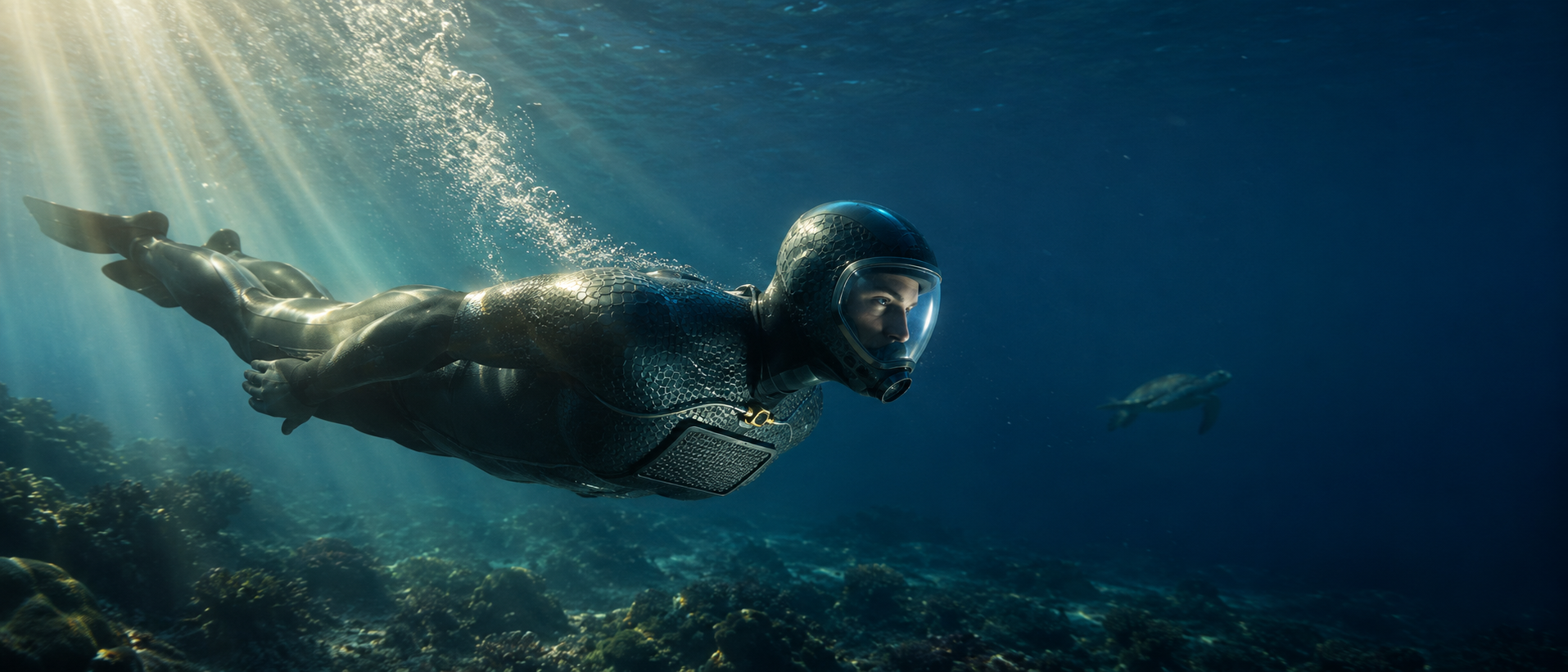
Recreational to military.
Same physics. Different specifications.
Every AquaSuit SKU runs the same passive mechanism stack. Higher SKUs add materials upgrades, integrated ballast systems, and mission-specific sealing — not different biology.
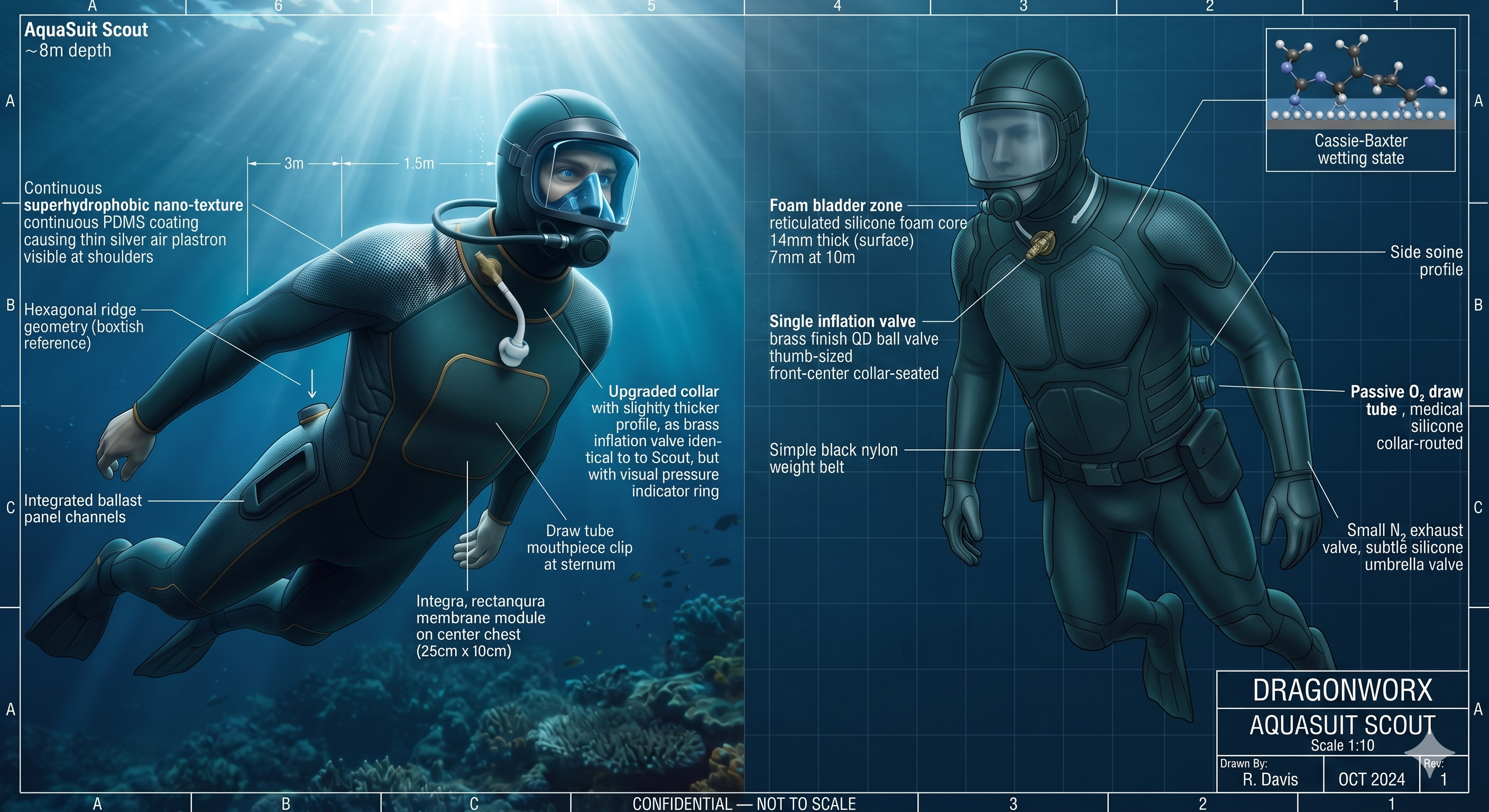
- Depth range 0–15 m
- Membrane module —
- CO₂ scrubber Soda-lime cartridge
- Weight ~4.2 kg
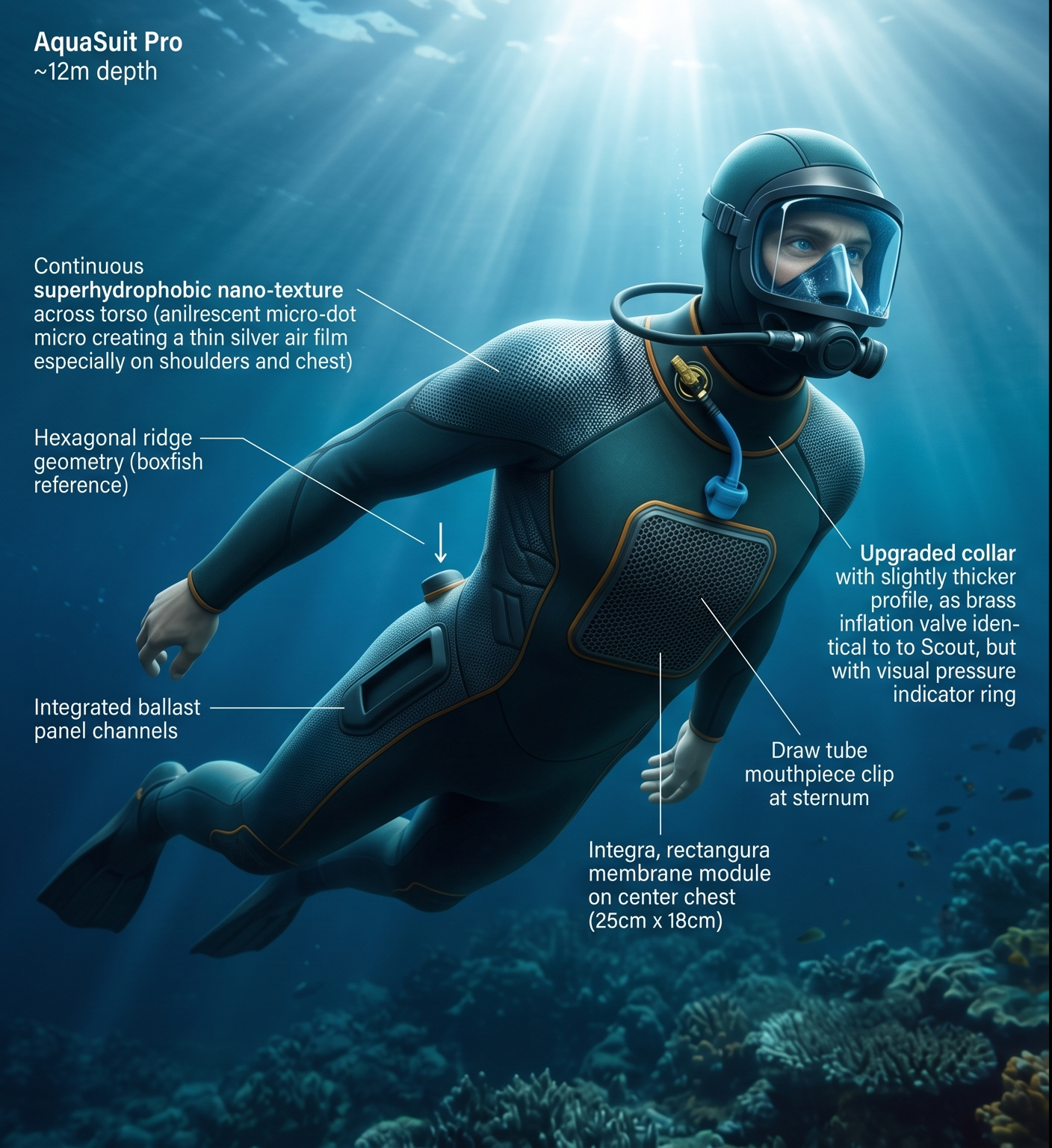
- Depth range 0–25 m
- Membrane module PIM-EA-TB HF
- CO₂ scrubber Enzymatic (seasonal)
- Weight ~5.0 kg
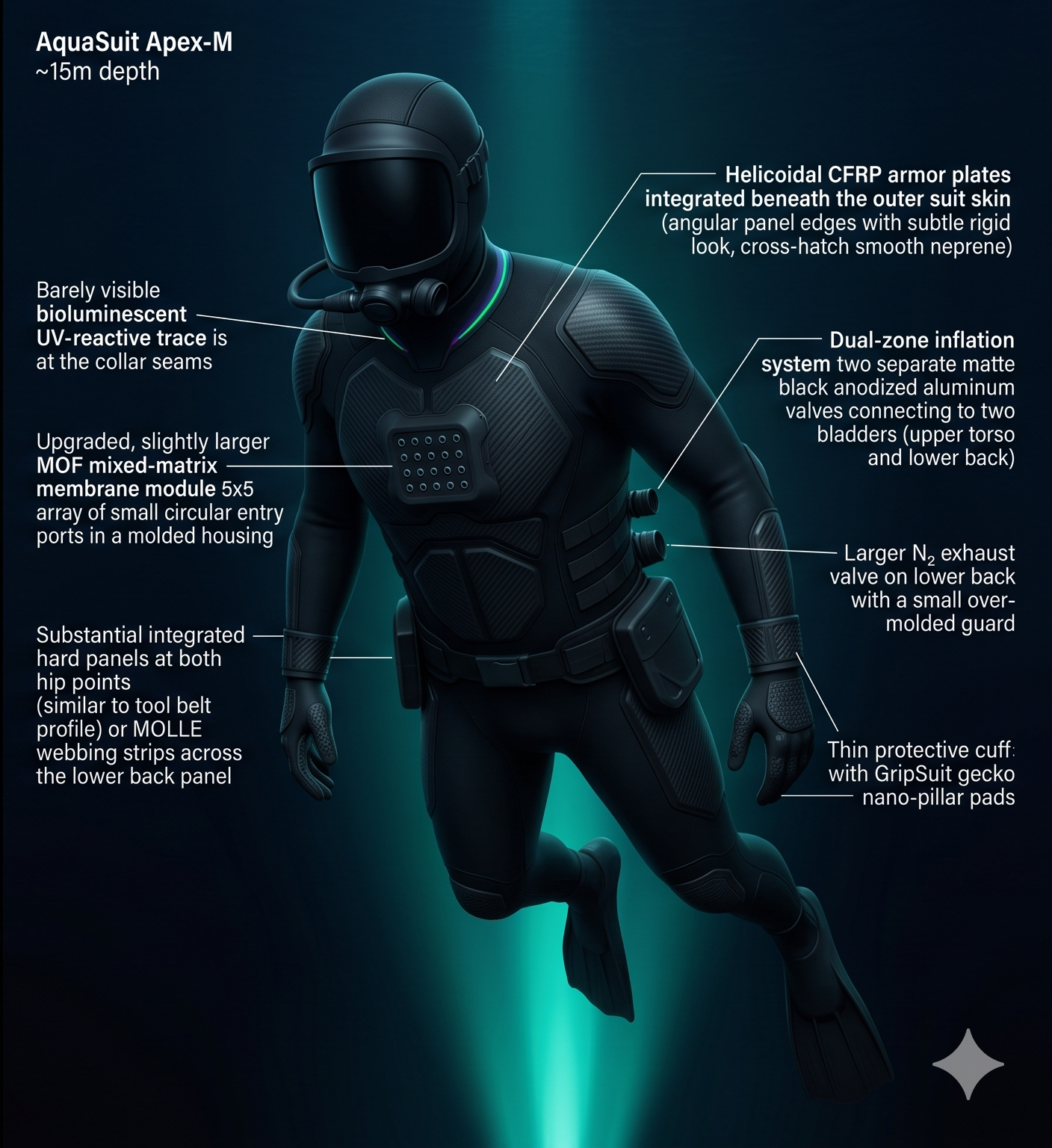
- Depth range 0–30 m
- Membrane module MOF mixed-matrix
- CO₂ scrubber CA enzyme layer
- Weight ~6.5 kg
Four reasons this doesn't get
copied in 18 months.
Pressure-driven O₂ enrichment IP
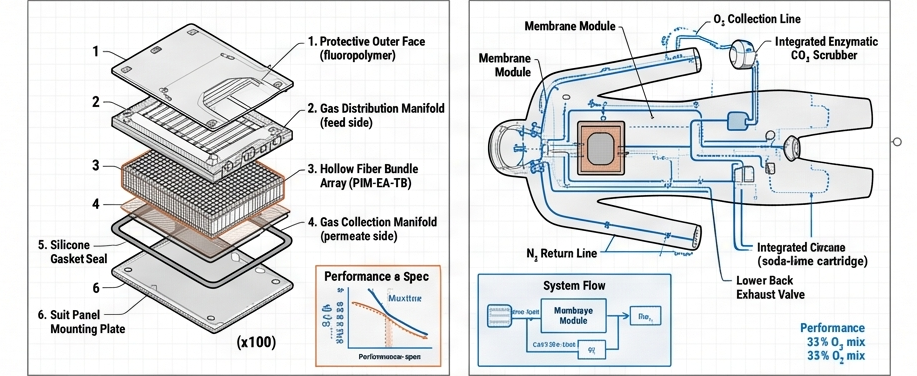
Using depth pressure as a passive driving force across an O₂-selective membrane — with no pump, no compressor, no power — constitutes a novel application of known membrane chemistry. The specific suit-integrated hollow-fiber geometry, gas manifold routing, and passive N₂ exhaust valve configuration represents patentable architecture.
Self-distributing foam bladder design
The reticulated silicone foam core that self-inflates at surface, distributes air without palpable humps, and compresses predictably with depth — while simultaneously serving as the suit's thermal insulation layer — combines multiple existing technologies in a configuration that has no prior art in the diving equipment space.
CAM-derived fractal membrane geometry
The chorioallantoic membrane-inspired fractal fiber architecture — branching hollow fibers following Murray's Law spacing, with a sub-500nm active layer — represents a manufacturable improvement over current uniform-diameter hollow-fiber modules. This geometric IP applies across any gas separation membrane product, well beyond the AquaSuit.
Enzymatic CO₂ scrubber — no consumables
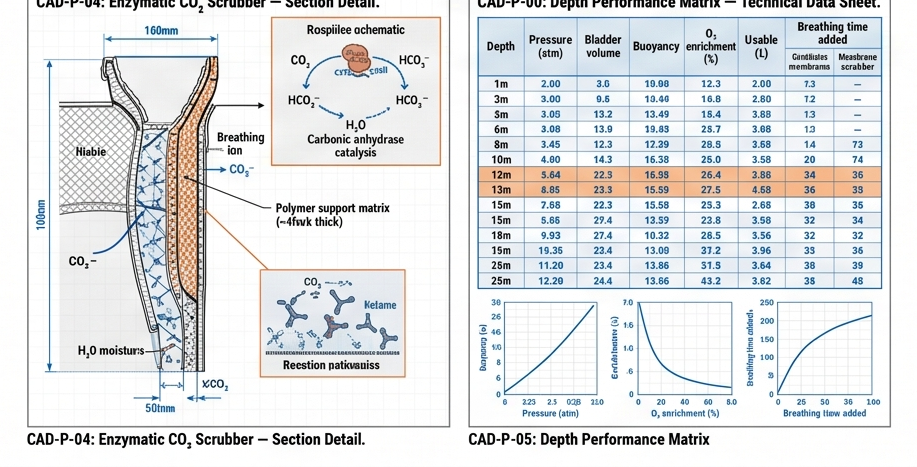
Immobilized carbonic anhydrase replacing the soda-lime scrubber cartridge eliminates the recurring consumable entirely and operates at ambient water temperature. The suit-integrated enzyme support structure and wet-environment stability improvements required to achieve a 6–18 month service life constitute a novel manufacturing process defensible under trade secret protection.
24 months to Pro SKU.
Scout in 18.
Component validation
Reticulated silicone foam bladder pressure-cycle testing. Superhydrophobic coating durability in saltwater. Passive draw-tube and N₂ exhaust valve bench verification. Off-the-shelf PDMS hollow-fiber membrane module sourcing and O₂ enrichment measurement at 1–3 atm differential.
Scout prototype + pool trials
First integrated AquaSuit Scout prototype. Controlled pool breath-hold timing trials vs. unassisted snorkel baseline. Buoyancy characterization at 3m, 5m, 10m. Failure mode enumeration — valve, seal, and tube routing. Weight belt integration testing.
Scout commercial release + Pro development
Scout SKU into limited production (100-unit pilot). PIM-EA-TB hollow-fiber membrane development partnership initiated. Enzymatic CO₂ scrubber material sourcing. Pro prototype construction begins. University partnership proposal — fractal membrane geometry fabrication research.
Pro prototype + open-water trials
AquaSuit Pro integrated prototype with full membrane module. Open-water trials across depth range and water conditions. Enzymatic scrubber service-life testing. First Responder market validation interviews. CE/UL certification pathway initiated.
Pro commercial + Apex-M development
Pro SKU into production (500-unit run). MOF mixed-matrix membrane development for Apex-M. ArmorSuit CFRP shell integration. Military partner engagement. IP filing across bladder architecture, fractal membrane geometry, and enzymatic scrubber configuration.
Depth pressure does the work.
The suit just captures it.
The AquaSuit mechanism doesn't fight the underwater environment — it uses it. Atmospheric pressure charges the system at the surface. Depth pressure compresses and enriches. Boyle's Law runs the buoyancy math passively. The diver controls nothing; the physics controls everything.
The self-inflation problem
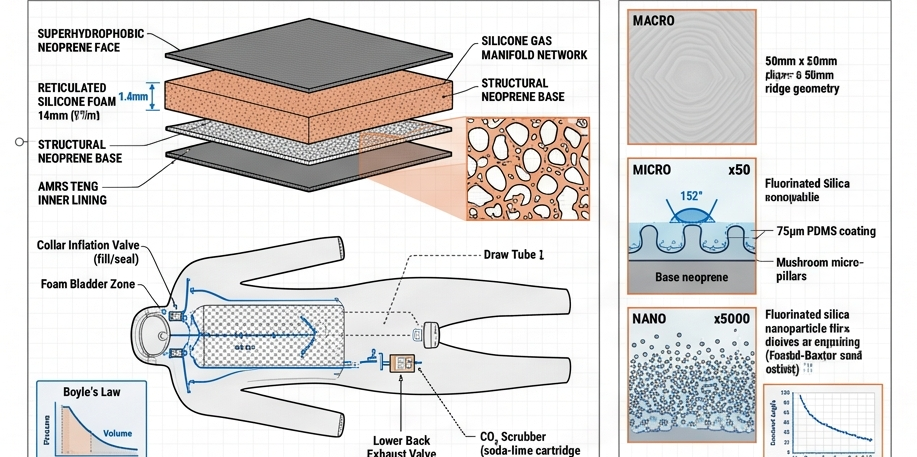
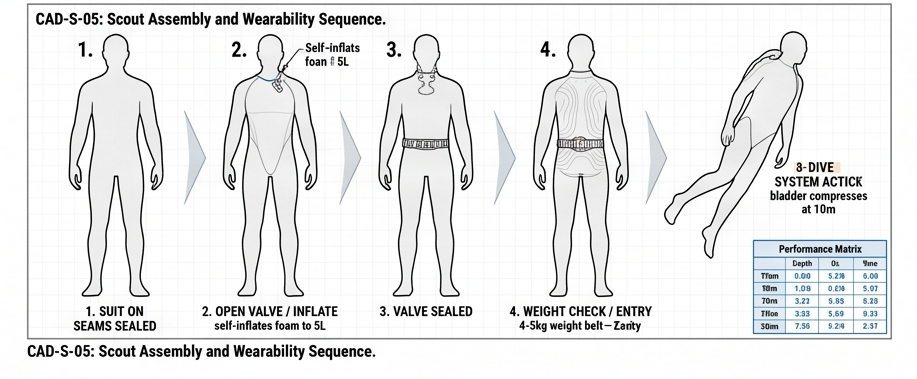
The first design challenge: how do you store meaningful air volume in a suit without creating rigid bladder humps that make the garment unwearable? The answer comes from self-inflating sleeping pad technology — reticulated open-cell foam inside a sealed airtight shell. Open the collar valve at the surface, the foam expands, the suit draws air through the distributed network passively, the valve seals. At the surface the foam sits 10–15mm thick; at 10m it compresses to 5–6mm — indistinguishable from a standard wetsuit.
Boyle's Law then does something useful: at 10m the stored 8L becomes 4L, cutting positive buoyancy in half automatically. The diver descends against modest lift for the first 3–5m, then the suit becomes near-neutral. On ascent, the air re-expands — a natural safety signal that the diver needs to surface.
The O₂ enrichment mechanism
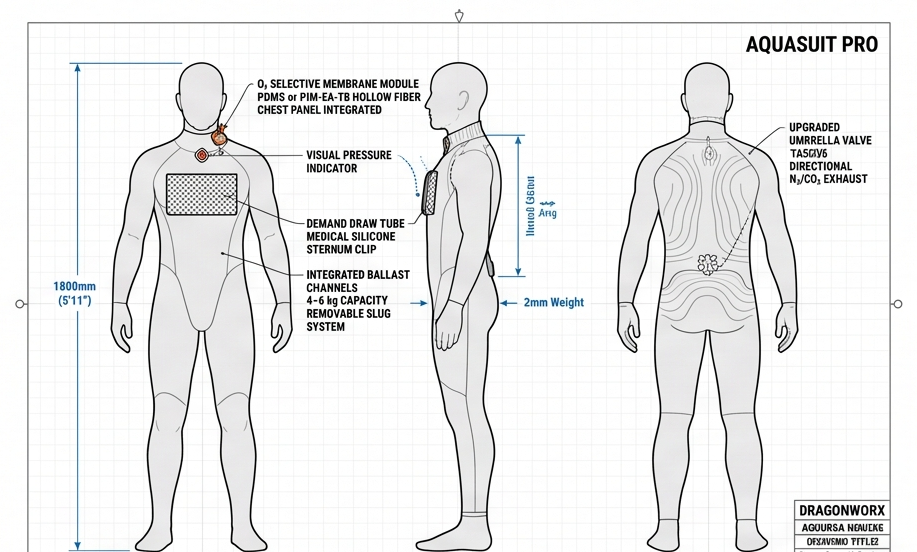
Compressed air in the suit at 2 atm (10m depth) contains O₂ at higher partial pressure than the breathing chamber. A selective O₂-permeable membrane between the bladder zone and the breathing chamber allows O₂ to migrate preferentially across the pressure differential. N₂ — larger kinetic diameter, lower membrane affinity — stays on the high-pressure side and vents through a passive umbrella valve at the suit's lower back.
The deeper the dive, the harder the pressure differential drives the membrane — the system becomes more effective exactly when the diver needs it most. No pump. No power. Depth itself runs the concentrator.
What nature built.
What we kept. What we left behind.
The AquaSuit design started with an open canvas of aquatic biological solutions — then ran each through a strict three-gate feasibility filter. Several mechanisms merged. Several inspired materials without becoming components. Two were abandoned for now. The decisions and the reasoning follow.
Boxfish hull geometry
The boxfish generates self-correcting vortices from its rigid hexagonal hull — passive yaw stability with zero muscular effort. The suit's outer panel geometry replicates the ridge profile, creating lateral vortex pairs that resist rotational drift during static hover at depth. This addresses a real freediver problem: maintaining position without fin sculling consumes O₂.
Water strider / diving beetle plastron
The diving beetle's superhydrophobic hair layer traps an air plastron that functions as a physical gill — O₂ diffuses from water into the trapped bubble as the insect consumes it, driven by partial pressure differential. For the suit, a dense nanotextured surface (lotus-effect PDMS or fluorinated silica coating) serves dual purpose: 30–40% drag reduction and passive O₂ supplementation via diffusion. At 0–15m, the plastron contributes roughly 0.1–0.7% of resting O₂ need — marginal alone, meaningful in combination.
Bladderwrack air vesicles
Bladderwrack's gas-filled sealed pockets maintain positive buoyancy passively — no muscular or neural action, simply sealed Boyle-Law-governed chambers. The AquaSuit's reticulated foam bladder achieves the same outcome more elegantly: instead of discrete bladder cells that create palpable structure, continuous open-cell silicone foam distributes air uniformly across the torso and back panels. Bladderwrack's architecture inspired the concept; the implementation diverges from it for wearability.
Nautilus gas chamber valve
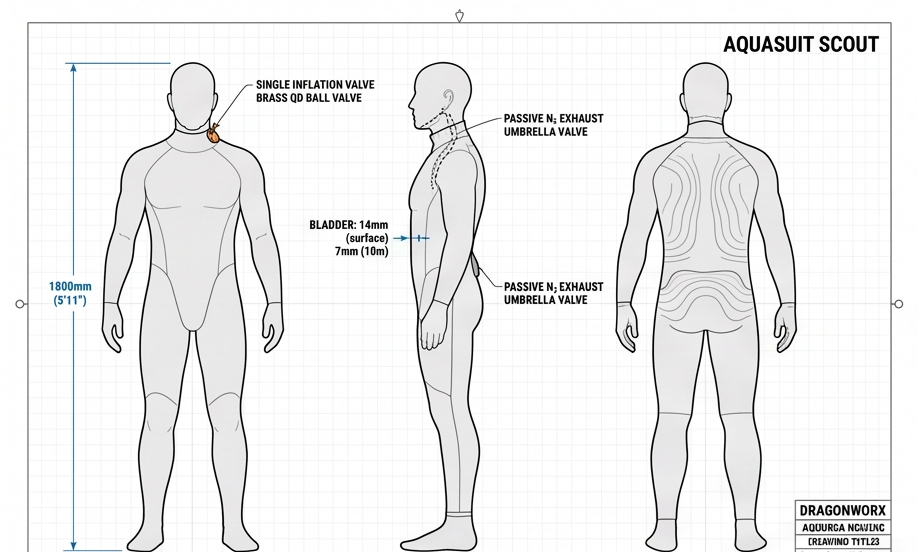
The nautilus adds or removes gas from sealed shell chambers via a thin siphuncle tube — depth control across 400m of vertical range, passively. For the suit, the siphuncle concept informs the collar inflation valve geometry: a simple QD (quick-disconnect) ball valve at the collar serves as the single fill point for the entire distributed foam network. On submerging, the sealed system behaves exactly as the nautilus chamber — pressure-governed, valve-isolated from atmosphere.
Bony fish swim bladder
Physoclistous fish seal their swim bladder and use a gas gland and oval (reabsorption) to adjust volume. The AquaSuit cannot replicate the biochemical gas secretion, but the oval's function — passive one-way gas bleed governed by pressure differential — maps directly onto the N₂ exhaust valve at the suit's lower back. Gas migrates upward toward the breathing chamber; spent gas and excess N₂ sinks and exits through the umbrella valve. The fish solved the directional venting problem 400 million years ago.
Chorioallantoic membrane (CAM)
The CAM exchanges gases through a three-layer architecture: an outer sub-micron epithelium minimizing diffusion distance, a fractal capillary network following Murray's Law to maximize surface area per volume, and an inner carbonic anhydrase-dense endoderm that actively clears CO₂ by converting it to bicarbonate. Three design lessons applied directly: (1) the AquaSuit membrane's active layer targets sub-500nm thickness (TFC geometry); (2) the hollow-fiber module uses Murray's Law branching rather than uniform cylindrical arrays; (3) immobilized carbonic anhydrase replaces the soda-lime scrubber cartridge in the Pro and Apex-M SKUs.
Weddell seal myoglobin loading
Weddell seals achieve 80-minute dives via extraordinary myoglobin density — ~10× human muscle O₂ capacity. A suit analog would require a PFC (perfluorocarbon) or cobalt-porphyrin O₂-binding inner lining that loads at surface partial pressure and releases at lower partial pressure near the diver. PFC emulsions work in clinical blood substitutes. However, at the thickness achievable in a suit lining, PFC O₂ release rates fall below measurement significance for breath-hold extension. Excluded from active stack — retained as a research direction if PFC membrane geometry improves. May re-enter at Apex-M specification with thicker collar reservoir.
PVDF piezo electrolysis
PVDF films harvesting body motion (~100mW) to power a PEM micro-electrolyzer could produce 0.3–0.5 mL O₂/min — roughly 0.2% of resting respiratory need. The output is real but the engineering overhead is significant: AC-to-DC rectification, supercapacitor accumulation, H₂ venting safety, and PEM cell hydration management all add complexity without approaching the breath-extension output of the bladder compression mechanism alone. Excluded from the AquaSuit stack as a primary mechanism. Retained as a platform note — if the ElectraSuit PVDF harvesting architecture matures, the micro-electrolyzer supplements the AquaSuit Pro's O₂ budget as a passive bonus layer. Not designed in; designed for.
The layer stack.
What each layer does.
Dial in the variables.
See the real numbers.
All figures derive from Boyle's Law compression, standard atmospheric O₂ fraction (21%), and measured human resting O₂ consumption. The membrane slider applies published permeance figures for PIM-EA-TB. The CO₂ scrubber toggle adds a 25% time extension based on the CO₂-first surfacing signal physiology.
Explore deeper — opens Claude in a new window
The O₂ selectivity landscape.
Where the AquaSuit sits.
Every O₂/N₂ separation membrane trades permeability against selectivity — the Robeson upper bound describes the empirical ceiling of existing polymer chemistries. The AquaSuit targets the upper-right: high permeability and meaningful selectivity. Current candidates sit at the edge; CAM-derived improvements could push past it.
How the suit was built.
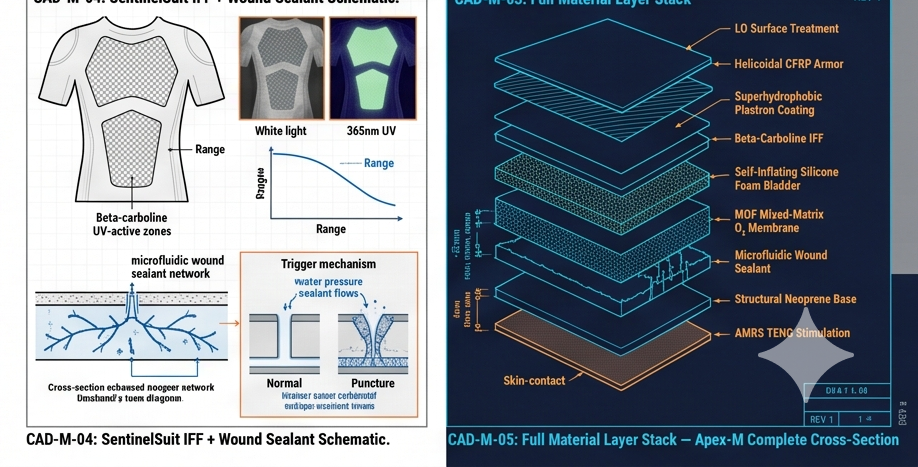
The drawings behind the design.
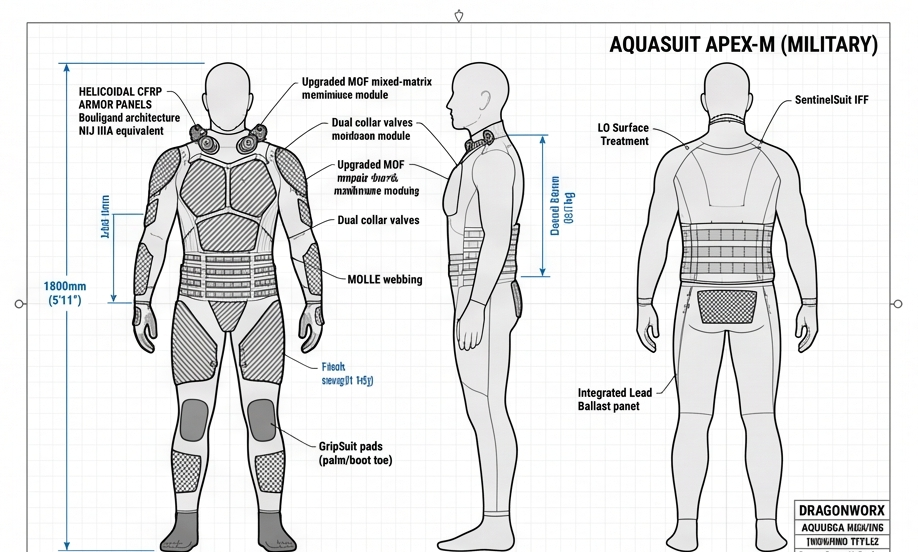
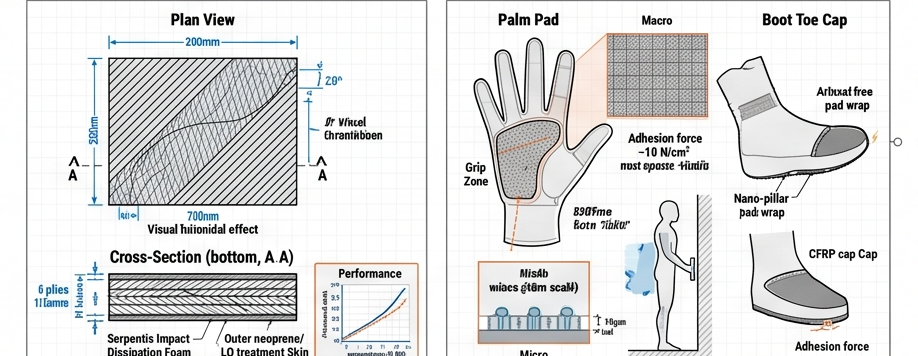
Each drawing set covers the orthographic three-view, layer stack section, gas circuit, and material detail for that SKU. Drawings generated from the DragonWorx engineering specification at Scale 1:10.
How the stack was built.
The reasoning behind every decision.
The DragonWorx methodology: identify the biological mechanism, understand the physics at the material level, find the fabrication path, test against hard constraints. Every proposed mechanism ran three gates before inclusion in the AquaSuit stack.
Start with the diver's actual problem
The design brief wasn't "make a better wetsuit." It was: extend breath-hold time and control buoyancy passively, with no batteries, no tanks, no active components. The pearl diver / Ama diver model — 2–4 minute dives at 10–20m, no equipment — defined the performance target. Everything in the stack had to help a casual diver approach that benchmark without the decades of CO₂ tolerance training.
The three-gate filter ran every proposed mechanism: (1) no active power required; (2) the physics of the mechanism at human scale actually produces meaningful output; (3) materials exist in established supply chains at cost structures compatible with a sub-$1,600 product.
The buoyancy-breathability tradeoff — the central constraint
The key tension in the AquaSuit: every liter of air stored for breathing adds exactly one kilogram of positive buoyancy. There's no physical workaround. The design response was twofold: (1) use depth compression (Boyle's Law) to halve the buoyancy at dive depth, making the problem manageable underwater; (2) integrate the ballast system directly into the suit's hip and lower back panels rather than requiring a separate weight belt. The self-inflating foam core came from recognizing that discrete bladder cells create uncomfortable rigid pockets — the sleeping pad analogy delivered uniform distribution with no structural additions.
The CO₂ signal — what actually makes divers surface
The Ama diver insight reframed the problem. The urge to surface during a breath hold comes from CO₂ accumulation, not O₂ depletion — CO₂ partial pressure triggers the respiratory drive well before O₂ drops to dangerous levels. A passive CO₂ scrubber — soda-lime chemistry at the Scout level, immobilized carbonic anhydrase at Pro and Apex-M — delays this signal without generating O₂. Combined with the compression-derived O₂ supply, both sides of the breath-hold equation improve simultaneously: more O₂ in, CO₂ signal delayed.
The electrolysis branch — explored, set aside
The ElectraSuit PVDF piezo architecture (body-motion energy harvest, ~100mW) raised a natural question: could that current run a PEM micro-electrolyzer and generate O₂ from water directly? The physics works — 100mW at 70% efficiency produces roughly 0.35–0.45 mL O₂/minute. Human resting O₂ consumption runs ~250 mL/minute. The honest output is 0.2% of respiratory need — real but below meaningful threshold. The galvanic seawater battery path (Mg/C galvanic pair, no harvesting needed) reaches similar numbers. Both mechanisms excluded from the active AquaSuit stack; retained as integration notes if the ElectraSuit platform matures. The right home for PVDF electrolysis is a combination AquaSuit + ElectraSuit layer, not a standalone AquaSuit feature.
The chorioallantoic membrane — biology iterating back on the solution
After establishing the membrane concept on engineering grounds (pressure-swing, selective polymer), the CAM emerged as a biological system that had solved a nearly identical problem: gas exchange across a thin membrane, under a passive driving force, with CO₂ managed enzymatically, in a wet environment, with no moving parts. The CAM didn't inspire the membrane concept — it refined it. Three specific improvements: sub-micron active layer (TFC geometry), fractal fiber branching (Murray's Law, matching the CAM's capillary tree), and carbonic anhydrase replacing soda-lime. This feedback loop — engineering → biology → back to engineering — represents the DragonWorx methodology working as intended: biomimetics as a refinement pass, not just a starting point.
The AquaSuit platform
reaches beyond diving.
DragonSuit
The shark-denticle riblet surface validated for the DragonSuit's aerodynamic drag reduction (8–10%) applies identically to the AquaSuit's hydrodynamic surface — the same laser-etched V-groove geometry, the same skin-friction reduction mechanism, different medium. Shared fabrication tooling and supply chain.
Explore DragonSuit →ElectraSuit
The PVDF piezo harvest architecture excluded from the AquaSuit on output grounds becomes a meaningful supplemental O₂ source in a combined AquaSuit + ElectraSuit layer configuration. The ElectraSuit's ~100mW harvest at swimming pace provides continuous trickle charge to a micro-electrolyzer — not enough to breathe, enough to extend a long slow dive.
Explore ElectraSuit →Membrane IP licensing
The CAM-derived fractal hollow-fiber geometry and the pressure-driven passive O₂ enrichment architecture apply beyond diving — industrial oxygen enrichment, hyperbaric medical applications, aquaculture oxygenation. The AquaSuit IP position creates licensing opportunities in adjacent markets where passive, mechanically simple O₂ concentration has value.
Discuss licensing →Verdant Tower
The AquaSuit's superhydrophobic nanotextured coating — lotus-effect PDMS or fluorinated silica — applies directly to Verdant Tower's exterior building envelope: fog collection, self-cleaning surfaces, and water-repellent structural panels. Same chemistry, radically different scale. Shared materials research pathway.