Termites build skyscrapers that regulate their own temperature without HVAC. Lotus leaves shed water and contaminants without detergent. Spider silk is stronger than steel at a fraction of the weight. The most advanced sustainable building is not solar panels on a conventional structure — it is a structure that copies the physics of organisms that solved these problems first.
Most "sustainable" buildings are conventional buildings with sustainable systems bolted on: solar panels, heat pumps, triple glazing, grey water recycling. The fundamental geometry and material logic of the building itself remains unchanged from its 20th-century precedents. This is the equivalent of improving a conventional wingsuit by choosing a slightly better fabric — it ignores the underlying physics problem.
The DragonWorx methodology asks: which organisms have solved the specific physical problems that buildings face? Temperature regulation. Structural load-bearing. Water management. Air quality. Embodied energy in materials. Each of these has biological precedents that outperform the current engineering state of the art.
🐜 Termite Mound — Passive Thermal Regulation
The African termite (Macrotermes michaelseni) builds mounds up to 6 meters tall that maintain an internal temperature of 31°C ± 1°C despite external temperatures ranging from 3°C to 42°C over a 24-hour cycle. No mechanical ventilation. No energy input. The mechanism is a network of channels that uses temperature differential between the core (metabolically heated by the colony) and the surface to drive convective airflow in a specific pattern — warm air rises through the central chimney, cools at the permeable outer wall, descends through peripheral channels, and cycles through the brood chamber.
The Eastgate Centre in Harare, Zimbabwe (architect Mick Pearce, 1996) implemented this principle directly — a commercial building with no conventional air conditioning that maintains comfortable temperatures using a chimney-and-channel system inspired by termite mound geometry. Energy use is approximately 10% of a comparable conventional building.
DragonWorx application: The channel geometry can be integrated into load-bearing wall panels manufactured from auxetic composite materials — the same negative-Poisson-ratio lattice geometry used in DragonSuit wing panels — allowing the thermal channel network to serve simultaneously as structural reinforcement. Wall panels that breathe by design.
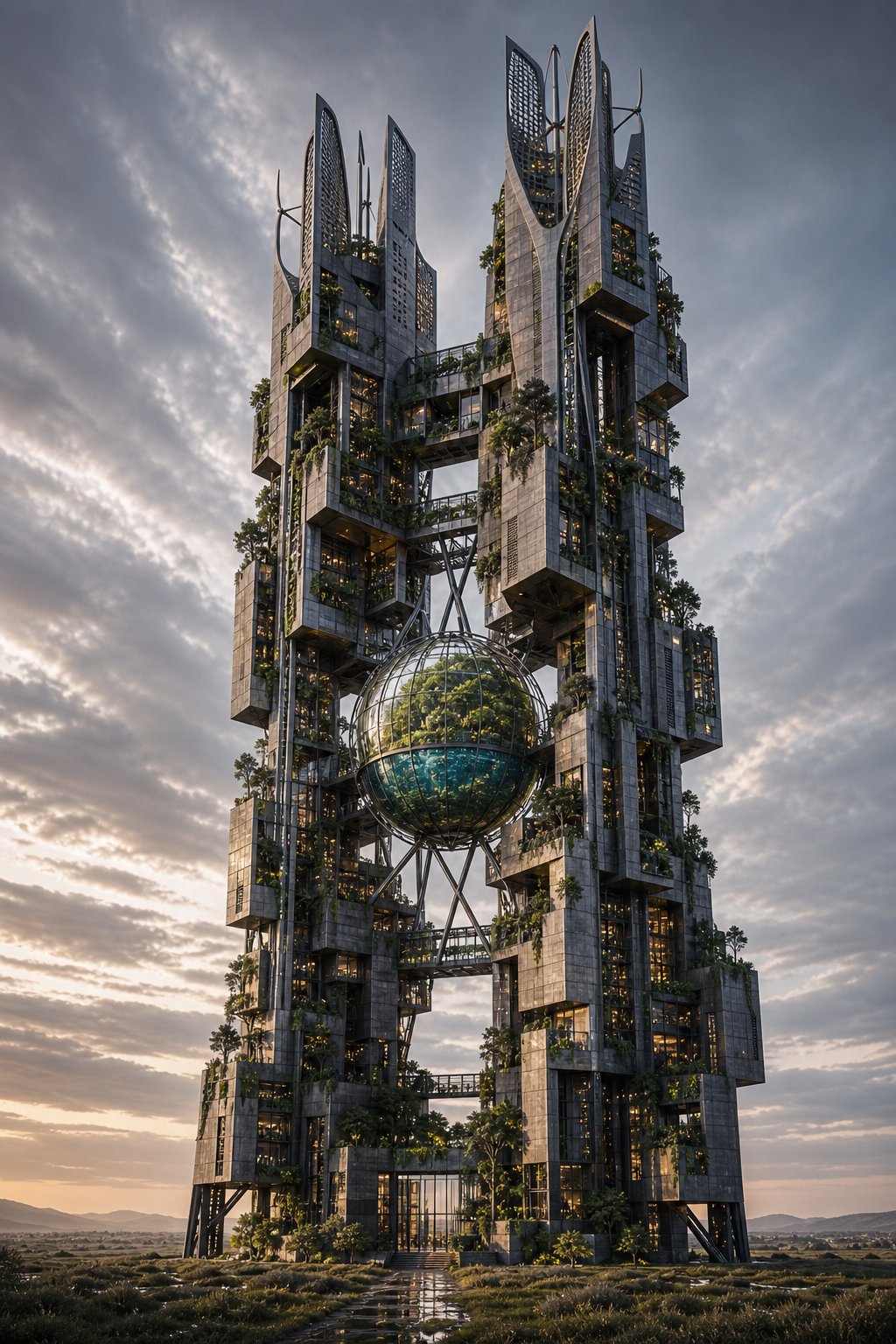
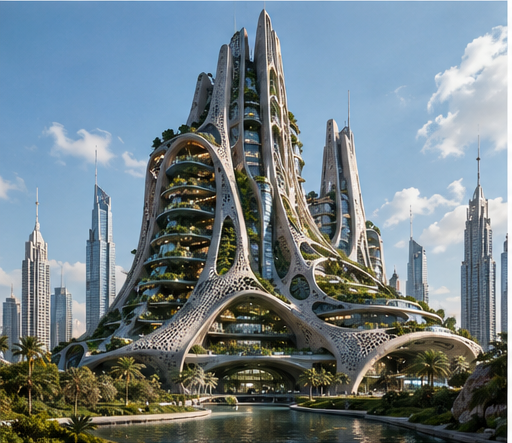
A termite-inspired arcology concept: the building's structural lattice doubles as a passive thermal chimney network. Warm air rises through the core, cools at permeable outer walls, and descends through peripheral channels — no mechanical HVAC required. Based on the same principles as the Eastgate Centre, Harare (Mick Pearce, 1996).
🌸 Lotus Effect — Self-Cleaning Exterior Surfaces
The lotus leaf (Nelumbo nucifera) achieves a water contact angle above 150° through a hierarchical surface structure: micro-scale wax crystals on top of micro-scale papillae. Water droplets bead and roll off, carrying contaminants with them. The surface never gets wet in any meaningful sense. The mechanism is the Cassie-Baxter wetting state — air pockets trapped in the surface roughness prevent the liquid from contacting the underlying material.
This is the same superhydrophobic surface mechanism used in the DragonWorx AquaSuit proposal. At building scale, it eliminates the need for exterior cleaning, prevents biological growth (mold, algae, lichen), and dramatically extends the service life of exterior surfaces. ISPO and several German building material manufacturers have commercialized lotus-effect exterior coatings, though none have applied them in combination with structural metamaterial panels.
🕷️ Spider Silk — High-Tensile Structural Members
Dragline silk from Nephila spiders has a tensile strength of 1.1–1.4 GPa with 27–40% elongation before failure — exceeding high-tensile steel (0.4–0.8 GPa) at approximately 1/6 the density. The mechanical properties arise from a hierarchical structure of crystalline beta-sheet nanocrystals embedded in an amorphous matrix, producing a material that is simultaneously strong and highly extensible.
Recombinant spider silk production has reached commercial scale (Bolt Threads, Spiber). At building scale, spider-silk-equivalent tensile members would allow dramatically thinner structural sections with improved seismic performance — the high elongation acts as passive energy absorption during seismic loading. Combined with helicoidal CFRP joints (the ArmorSuit Bouligand structure), you have a building structural system where both the tensile members and the connection nodes are biomimetically optimized for impact and fatigue resistance.
🍄 Mycelium Composites — Living Structural Material
Mycelium — the root structure of fungi — can be grown into any form by controlling the substrate and growth conditions, producing a lightweight composite material with properties comparable to expanded polystyrene at a fraction of the environmental cost. Ecovative Design has commercialized mycelium packaging and insulation. The material is fully biodegradable, fire-resistant, and can be grown with negative carbon footprint using agricultural waste as substrate.
More interesting than the material itself is the growth logic: mycelium composites can be grown into structurally optimized forms that no conventional manufacturing process could produce — forms where the material distribution follows load paths exactly, as determined by finite element analysis, because the growth process can be guided by the nutrient distribution pattern. This is additive manufacturing by biology.
🐟 Boxfish Hull — Structural Geometry for Wind Load
The same boxfish hull geometry used in the DragonWorx AquaSuit applies to building form. The ridged, keeled geometry that generates self-correcting vortices for a swimming boxfish generates similar flow-stabilizing effects for a building in wind — the external surface geometry actively shapes the airflow around the structure, reducing peak wind pressure loads and the dynamic amplification that causes fatigue in tall buildings. The Mercedes-Benz Bionic Concept Car (2005) demonstrated 0.19 Cd from this geometry. A building skin with boxfish-derived surface geometry could reduce wind load design requirements by a meaningful fraction, allowing lighter structure.
Platform Convergence
The most important observation is that the DragonWorx metamaterials platform — auxetic panels, SMP elements, shark-denticle surfaces, helicoidal CFRP, superhydrophobic coatings — developed for wearable suits maps directly onto building applications. The IP portfolio being developed for the DragonSuit is also, without modification, a sustainable building materials IP portfolio. The same technology stack. Different form factor. Different market. Same physics.