DragonWorx.Bio / Projects / Project A
PROJECT A — ACTIVE DEVELOPMENT

DragonSuit

The first wingsuit designed from aerospace materials science first principles. Five-layer biomimetic composite stack. Four SKUs from consumer to military specification. Seed round in progress.

🐋 Humpback whale 🦈 Shark skin 🦅 Peregrine falcon 🦑 Flying squid NACA 4412 SMP skeleton Auxetic panels
THE TECHNOLOGY

Physics first. Materials second. Suit last.

Every wingsuit before this was designed empirically — a practitioner sewed fabric between their limbs and iterated if they survived. No computational fluid dynamics. No aerospace materials. No physics-first design methodology. The DragonSuit is what happens when you run the physics properly.

Technical Research Proposal
DragonSuit Apex — Wind Tunnel Validation Program
28 pages · 12 engineering drawings · Five-layer composite stack, full instrumentation spec, TRL matrix, development timeline. Submitted to a university aerodynamics research program, May 2026.
Download PDF →
BIOMIMETIC · TRL 4

🐋 Tubercle Leading Edges

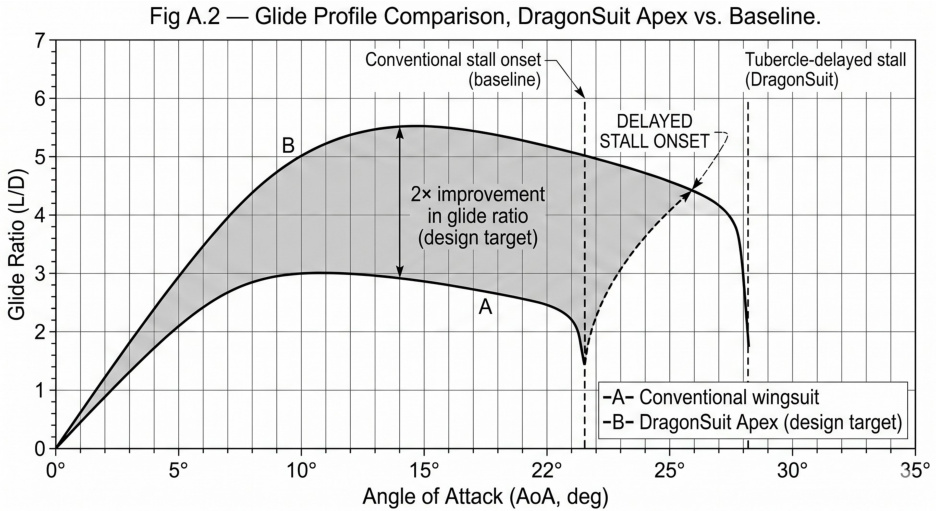
Sinusoidal bumps from humpback whale pectoral fin geometry, applied to the arm-wing leading edge. Wavelength ~30% chord, amplitude ~5% chord. Delays stall from 22° to 28° angle of attack. Breaks the stall front into discrete spanwise cells via controlled micro-turbulence injection. Implemented as a precision TPU-molded strip on the Apex; silk-screened surface approximation on the Scout.

METAMATERIAL · TRL 4

🔬 Auxetic Panel — Self-Cambering Wing

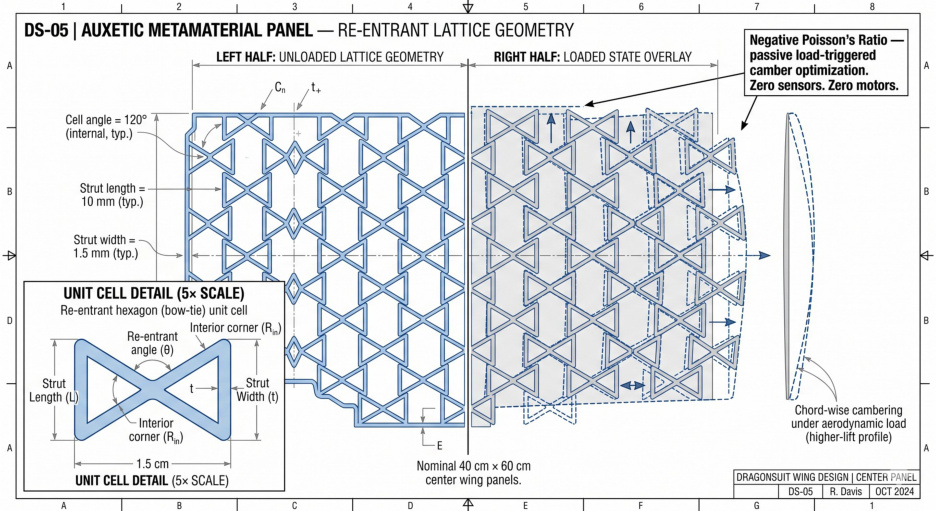
Negative Poisson's ratio re-entrant lattice embedded in the center wing panel. Under aerodynamic load, lateral expansion curves the chord into a higher-lift cambered profile — the wing optimizes itself in response to the forces it experiences. Zero sensors, zero motors, zero feedback loop. Passive, load-triggered, geometry-based.

SMART MATERIAL · TRL 4

🦴 Shape-Memory Polymer Skeleton

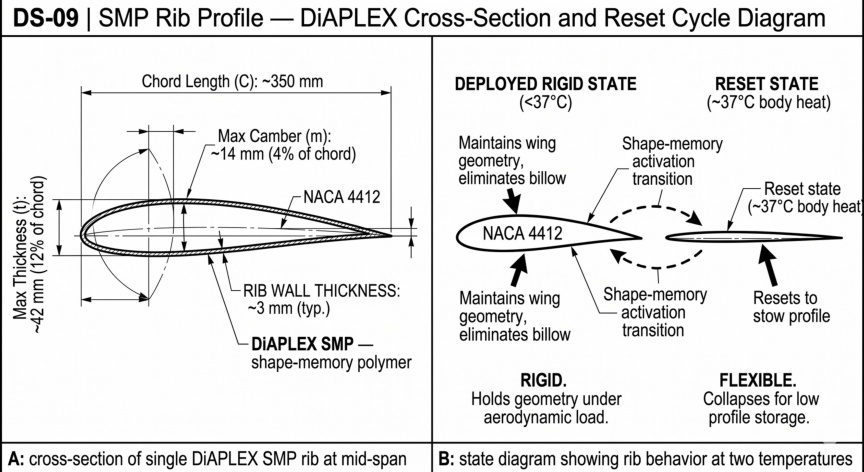
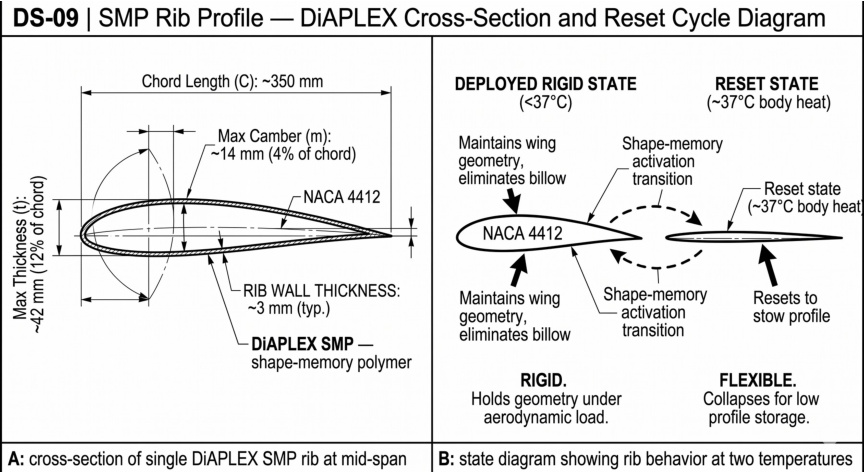
DiAPLEX SMP ribs profiled to NACA 4412 cross-section. Hold the wing geometry under aerodynamic load — eliminating the fabric billow that degrades every conventional wingsuit's aerodynamic profile. Reset to flat at body heat (~37°C). No mechanical parts. This single technology accounts for the largest share of the projected glide ratio improvement.

SURFACE SCIENCE · TRL 6

🦈 Shark-Denticle Riblet Film

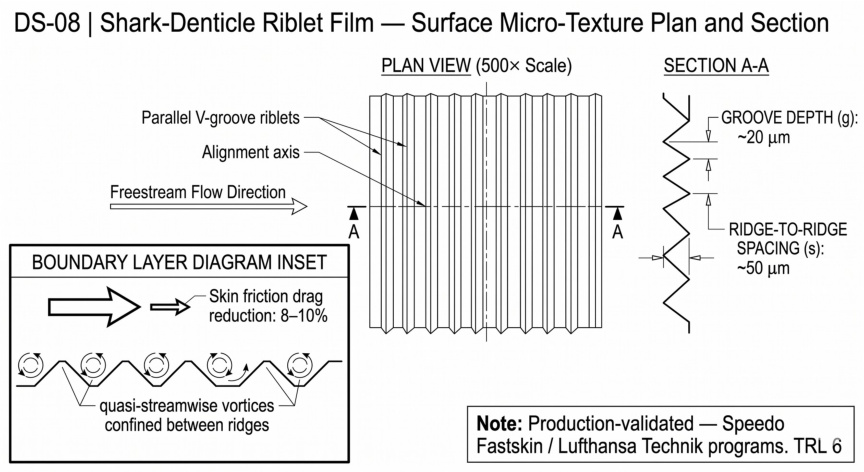
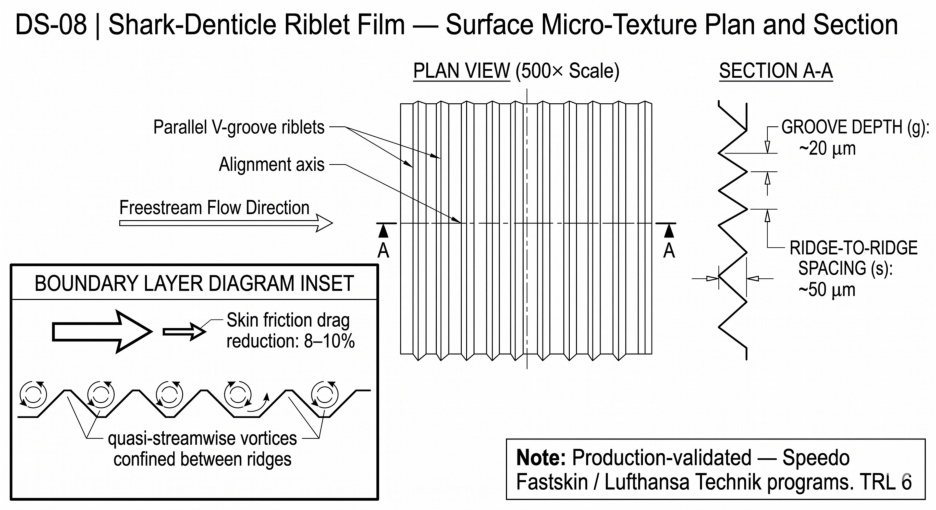
Laser-etched V-groove patterns confine quasi-streamwise vortices in the turbulent boundary layer, reducing skin friction drag 8–10% in both air and water. Production-validated in Speedo Fastskin and Lufthansa Technik riblet programs. The highest TRL technology in the stack — it works, it's been proven, and it applies to every other suit in the DragonWorx portfolio.

AERODYNAMIC · TRL 3

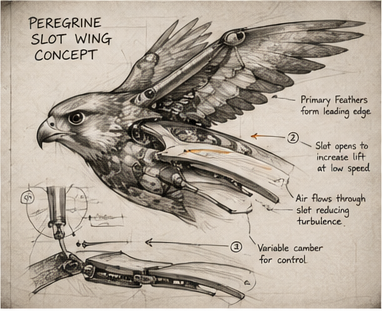
🦅 Peregrine Tip Slots

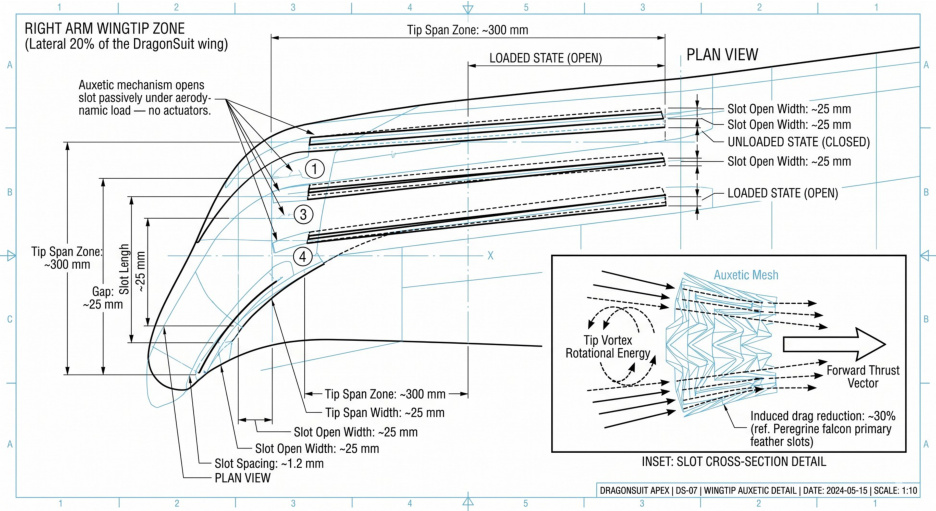
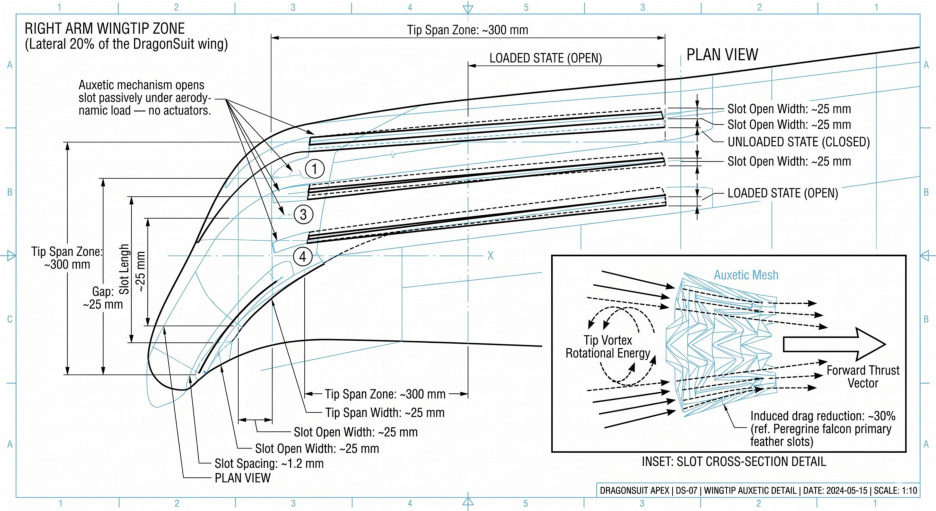
During a dive the falcon spreads primary feathers like fingers — each slot converts tip vortex rotational energy into forward thrust vectors, reducing induced drag ~30%. The DragonSuit implementation uses the auxetic panel mechanism at the wingtip: load passively opens slot gaps without actuators. The single largest remaining untapped improvement in the design. Deep dive: The Feathers That Fold Drag into Thrust →

STRUCTURAL · TRL 4–5

🔀 Anisotropic Washout Weave

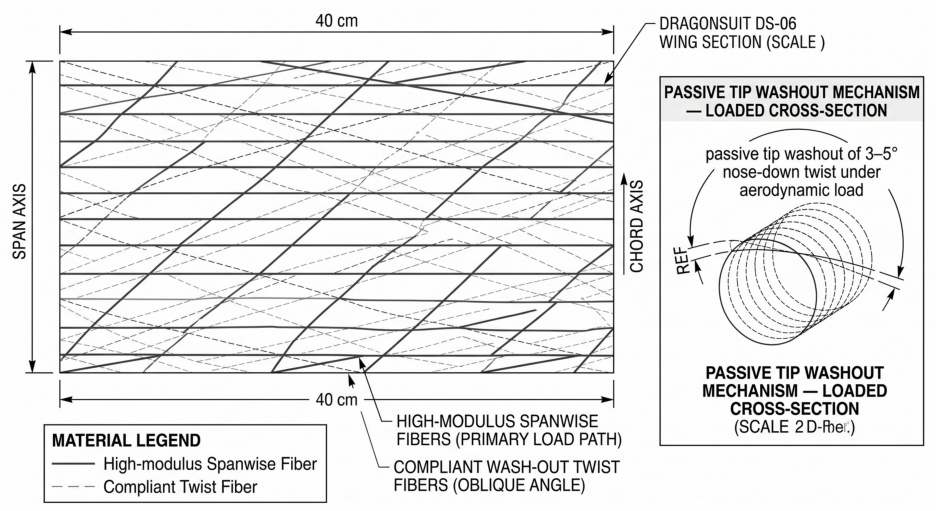
High-modulus fibers oriented spanwise with compliant fibers in the twist direction. Under load, the tip twists nose-down 3–5° passively — preventing tip stall through material stiffness gradient. Achieved entirely through the weave schedule. No added weight, no mechanical parts.
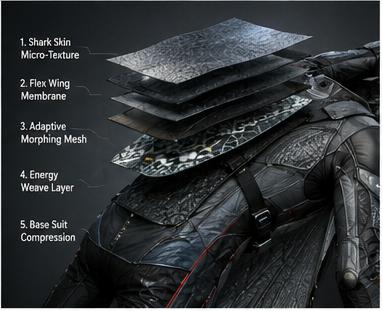
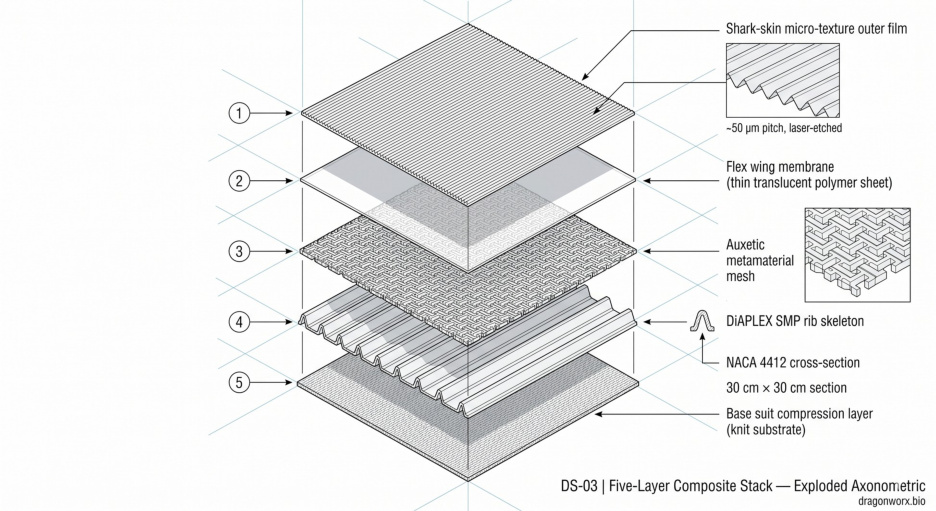
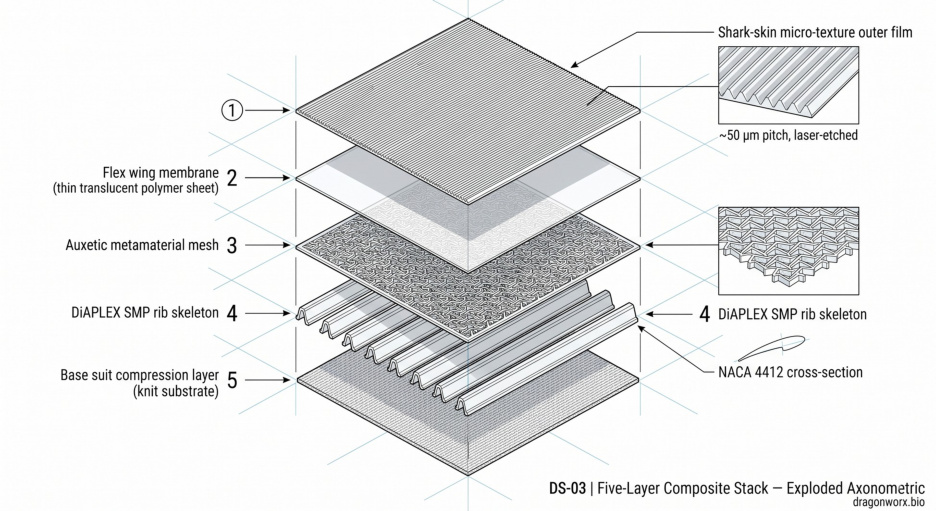
DragonSuit five-layer composite stack exploded diagram: (1) shark-skin micro-texture outer surface, (2) flex wing membrane, (3) adaptive morphing mesh, (4) energy weave layer, (5) base suit compression layer
Fig A.1 — Five-layer composite stack. Each layer addresses a distinct physics problem: drag, shape, stiffness, energy, and fit.
Peregrine falcon slot-wing mechanism engineering sketch annotating primary feather slot opening, variable camber control, and turbulence-reducing air flow path — the biological model for DragonSuit tip slot design
Fig A.2 — Peregrine slot-wing sketch. Slots open to increase lift at low speed; air flow through slot reduces tip turbulence.
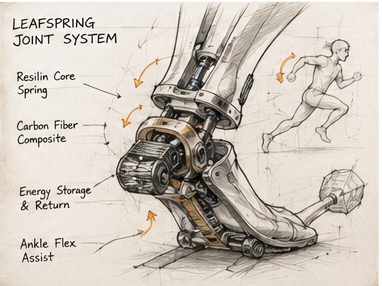
Leafspring joint system engineering sketch showing resilin core spring, carbon fiber composite structure, energy storage and return mechanism, and ankle flex assist — the JumpSuit design foundation
Fig A.3 — Leafspring joint system. Resilin + carbon fiber delivers 97% elastic energy return — the foundation for the upcoming JumpSuit platform.
DragonSuit pilot launching into a glide over a deep canyon river at sunset — demonstrating the consumer Apex SKU's open-air flight performance against a dramatic red-rock landscape
Consumer — DragonSuit Apex

Canyon glide launch at dusk. The Apex's SMP rib skeleton holds NACA 4412 geometry under full aerodynamic load — eliminating the wing billow that collapses conventional suits' glide performance at speed.

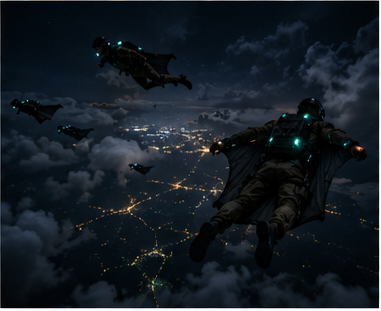
Military DragonSuit Apex-M operators conducting a high-altitude nighttime tactical insertion, gliding in formation over city lights — demonstrating the military SKU's low-observable profile and MOLLE integration
Military — DragonSuit Apex-M

High-altitude tactical insertion, formation flight. Apex-M adds helicoidal CFRP armor, NIJ-rated ballistic padding, and MOLLE attachment points over the full Apex aerodynamic stack.

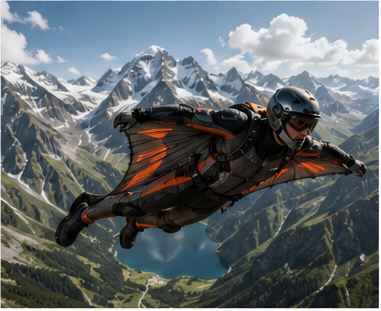
DragonSuit Scout pilot flying with orange accent wing panels over glaciated alpine ridges — the entry-level consumer SKU demonstrating stable 3.8–4.5:1 glide ratio performance

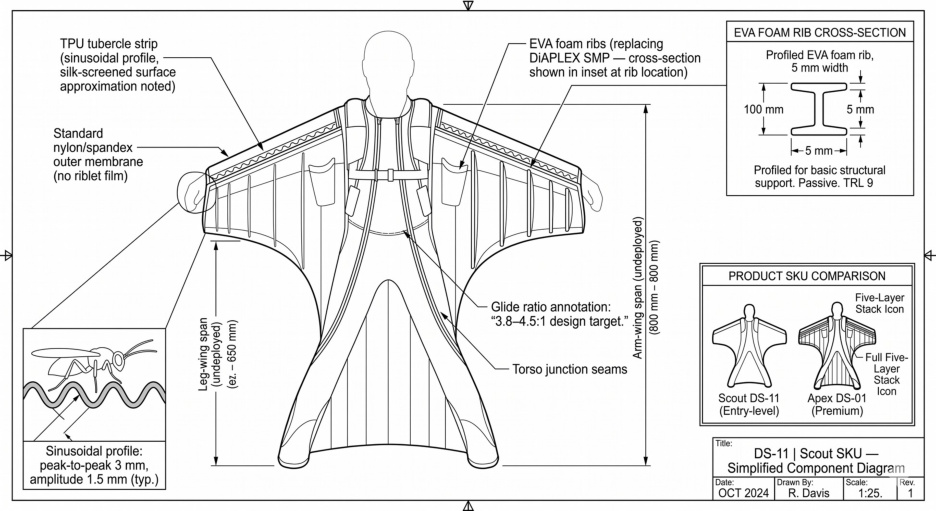
DragonSuit Scout — consumer entry SKU ($279–$349). EVA foam ribs and TPU tubercle strip. 3.8–4.5:1 glide ratio over alpine terrain.

PRODUCT LINE

Four SKUs. Three markets.

SKU Price Glide Ratio Min Altitude Key Differentiator Market
DragonSuit Scout $279–$349 3.8–4.5 : 1 ~120 ft EVA foam ribs + TPU tubercle strip Consumer / entry-level
DragonSuit Apex $10K–$18K 5.0–6.0 : 1 ~90 ft Full 5-layer SMP stack Elite pilots
DragonSuit Apex-M $28K–$45K 5.0–6.0 : 1 <90 ft Helicoidal CFRP + NIJ padding + MOLLE Military / SOF
DragonSuit Apex-SAR $18K–$24K 5.0–6.0 : 1 ~90 ft Beacon integration + high-vis panels Search & Rescue / Gov

Glide ratio and altitude figures are design targets based on CFD simulation and published literature for individual component technologies. Wind tunnel validation planned with a university aerodynamics research program.

PLATFORM EXTENSIONS

The DragonSuit composite stack — shark riblets, auxetic metamaterial, superhydrophobic surfaces — directly seeds the next three suit platforms. The same materials science, different operating domains.


AquaSuit researcher diving alongside a sea turtle in a tropical coral reef — the suit's boxfish-derived hull ridges and superhydrophobic plastron surface reducing hydrodynamic drag, with the shark-denticle riblet film shared directly from the DragonSuit material stack
AquaSuit — Shark-denticle riblet film (TRL 6 in DragonSuit) transfers directly to aquatic drag reduction. Boxfish hull ridges add passive yaw stability. The same surface science, a different fluid medium.
GripSuit operator scaling a glass skyscraper face at night using gecko-inspired Van der Waals dry adhesion — the nano-pillar array technology that pairs with the DragonSuit's auxetic panel geometry in a future multi-domain suit
GripSuit — Hierarchical gecko nano-pillar adhesion. 10 N/cm² dry, any surface. TRL 5 — the highest-readiness upcoming platform after AquaSuit.

The physics, drawn.

Engineering drawings and performance diagrams extracted from the wind tunnel research proposal. All figures GPT-4o synthesis from design narrative unless noted.
Overview
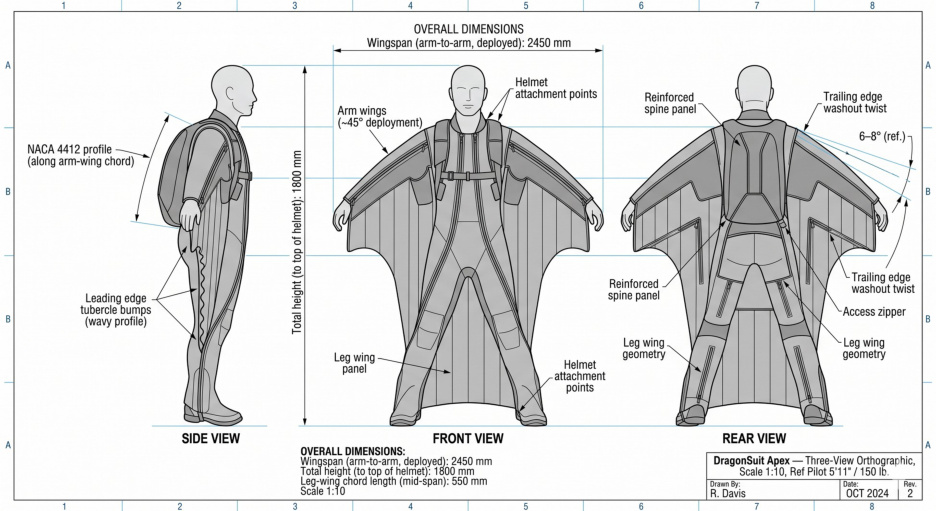
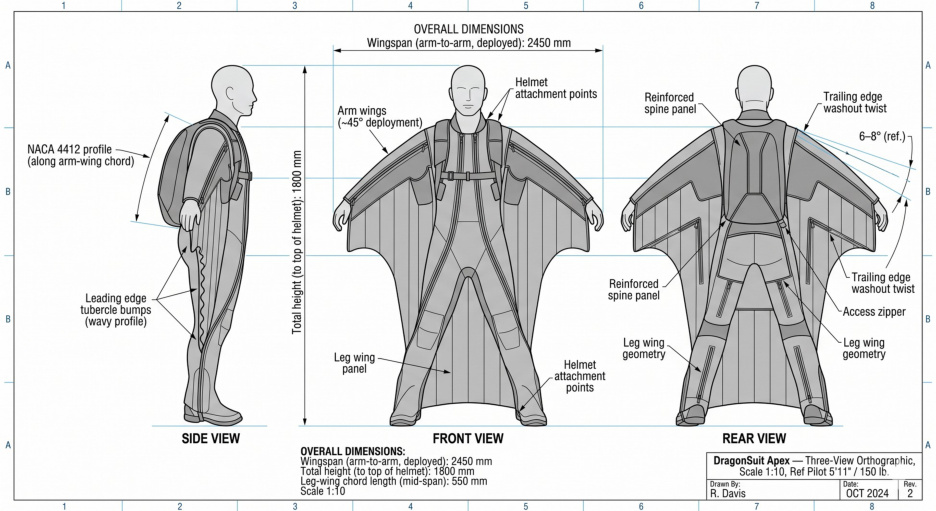
DragonSuit three-view orthographic — front, side, rear at scale 1:10
DS-01 Three-view orthographic — wingspan 2,450 mm arm-to-arm (deployed). Reference pilot 5'11" / 150 lb. Scale 1:10. NACA 4412 profile visible along arm-wing chord in side view.
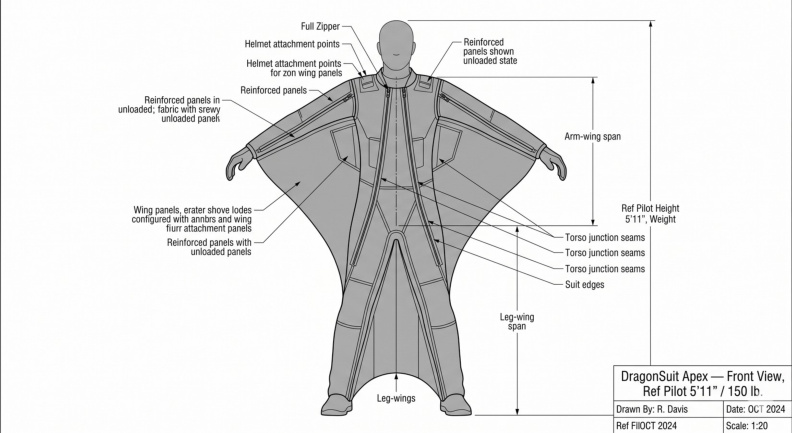
DragonSuit front-view orthographic — arm wings at 45° deployment
DS-12 Front-view orthographic. Arm wings at ~45° deployment. Leg-wing panel geometry and torso junction seams visible. Scale 1:20.
Five-Layer Composite Stack
Five-layer composite stack exploded axonometric
DS-03 Five-layer stack, exploded axonometric. From outer surface inward: (1) shark-denticle riblet film, (2) flex wing membrane, (3) auxetic metamaterial mesh, (4) DiAPLEX SMP rib skeleton, (5) base compression layer. 30 cm × 30 cm panel section.
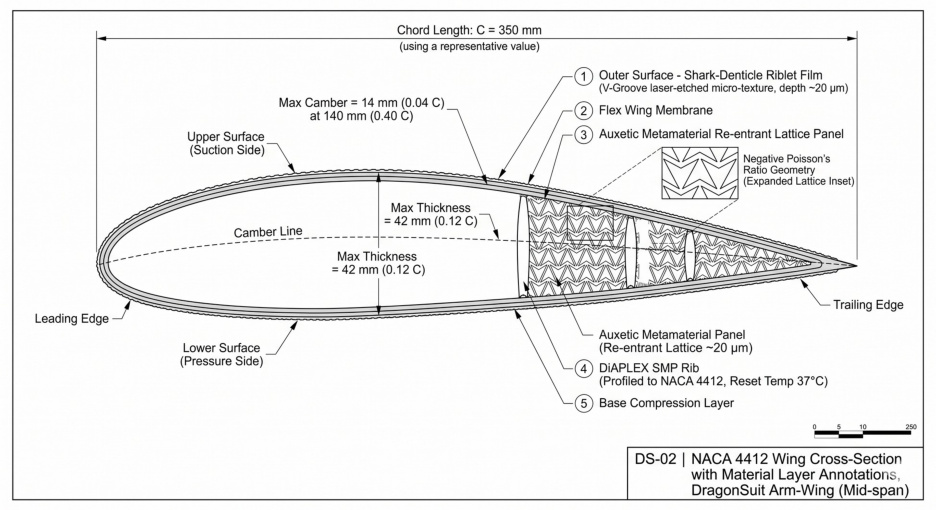
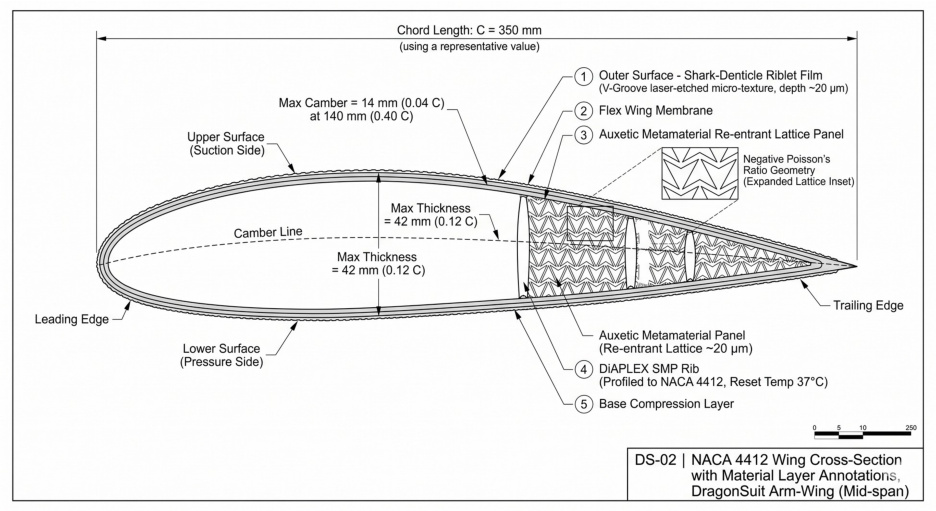
NACA 4412 arm-wing cross-section with five composite layer annotations
DS-02 NACA 4412 arm-wing cross-section, mid-span. Chord C = 350 mm. Max camber 14 mm (4.0%) at 40% chord. Max thickness 42 mm (12%). All five layers annotated at trailing-edge cutaway.
Shark-denticle riblet film surface texture at 500x scale
DS-08 Shark-denticle riblet film. Plan view at 500× scale — V-groove riblets aligned with freestream direction. Groove depth g ≈ 20 μm, spacing s ≈ 50 μm. 8–10% skin friction reduction. TRL 6, production-validated.
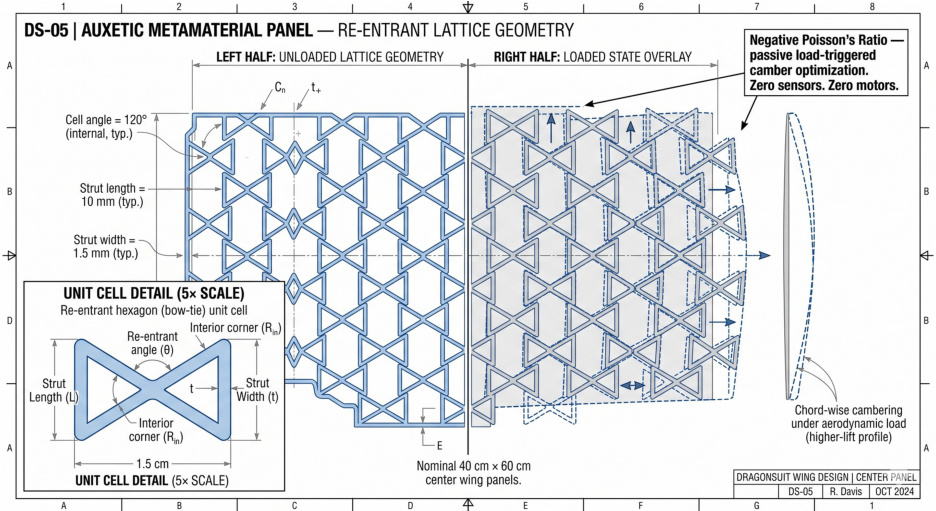
Auxetic metamaterial panel — re-entrant hexagonal unit cell, loaded vs unloaded
DS-05 Auxetic metamaterial panel. Left: unloaded re-entrant hexagonal lattice (L = 10 mm, t = 1.5 mm, θ = 120°). Right: loaded state overlay showing lateral expansion and chordwise cambering toward NACA 4412 target profile.
DiAPLEX SMP rib profile and two-state thermal cycle diagram
DS-09 DiAPLEX SMP rib profile. Chord C = 350 mm, NACA 4412 geometry. Two-state thermal cycle: glassy state below 37°C (rigid, holds wing geometry); rubbery state at 37°C (flexible, collapses to flat stow profile).
Biological Mechanism Technologies
Peregrine falcon tip slot — right arm-wing tip zone, four slot gaps
DS-07 Peregrine tip slot — right arm-wing tip zone (lateral 20% of span, ~300 mm). Four slot gaps shown unloaded (closed) and loaded (open, dashed). Slot width ~25 mm. Induced drag reduction target: ~30%.
Anisotropic washout weave — passive tip twist under aerodynamic load
DS-06 Anisotropic washout weave. 40 cm × 40 cm panel section. Primary spanwise load-path fibers + compliant oblique twist fibers. Passive tip washout 3–5° nose-down under aerodynamic load. No mechanical parts.
Performance Projections
Glide ratio comparison — conventional baseline vs DragonSuit Apex design target
DS-10 Glide ratio comparison. Curve A: conventional baseline, peak L/D ≈ 2.8–3.0 at ~12° AoA, stall at 22°. Curve B: DragonSuit Apex design target, peak L/D ≈ 5.5, stall delayed to 28°. CFD-based targets pending wind tunnel validation.
DragonSuit Scout simplified component diagram — entry-level consumer SKU
DS-11 DragonSuit Scout component diagram — entry-level consumer SKU ($279–$349). EVA foam ribs replace DiAPLEX SMP. TPU tubercle strip retained at leading edge. Glide ratio target: 3.8–4.5:1.
Engineering Drawing Package (DS-01 through DS-09)
DS-01 engineering drawing — three-view orthographic
DS-01/12 Engineering drawing — three-view orthographic. Scale 1:10. Front, side, rear with all critical dimensions labeled. Trailing-edge washout twist 6–8° annotated in rear view.
DS-02 NACA 4412 arm-wing cross-section engineering drawing
DS-02 Engineering drawing — NACA 4412 arm-wing cross-section. Chord C = 350 mm. All key dimensions, material annotations, and composite layer thicknesses.
DS-05 auxetic metamaterial panel engineering drawing
DS-05 Engineering drawing — auxetic metamaterial panel. Nominal dimensions 40 cm × 60 cm. Unit cell geometry, loaded and unloaded state overlay, chordwise camber response annotation.
DS-06 anisotropic washout weave engineering drawing
DS-06 Engineering drawing — anisotropic washout weave. Fiber architecture annotation, passive tip washout cross-section, 3–5° nose-down rotation under aerodynamic load.
DS-07 peregrine tip slot engineering drawing
DS-07 Engineering drawing — peregrine tip slot detail. Right arm-wing tip zone. Four slot gaps, unloaded (solid) and loaded (dashed). Vortex energy recovery diagram inset. Induced drag reduction target: ~30%.
DS-08 shark-denticle riblet film engineering drawing
DS-08 Engineering drawing — shark-denticle riblet film. Plan view at 500× scale, Section A-A cross-section. Groove depth g ≈ 20 μm, spacing s ≈ 50 μm. TRL 6, production-validated in Speedo Fastskin and Lufthansa Technik programs.
DS-09 DiAPLEX SMP rib profile engineering drawing
DS-09 Engineering drawing — DiAPLEX SMP rib profile and thermal state diagram. NACA 4412 cross-section at C = 350 mm. Two-state cycle: glassy (rigid, maintains geometry) and rubbery (flexible, collapses to stow profile at 37°C).
DOWNLOADS & SUPPORTING DOCUMENTATION

Full documentation.

Technical proposals, research documentation, investor materials, and project planning tools. All documents are confidential — not for redistribution without written consent.

Research Proposals
📄
DragonSuit Apex — Wind Tunnel Research Proposal
PDF · 23 pages · 12 engineering drawings · Submitted to a university aerodynamics research program · May 2026 — Five-layer biomimetic composite wingsuit: SMP ribs, auxetic panels, tubercle leading edge, shark riblets, peregrine tip slots. Projected 2× glide ratio improvement over best-in-class. Full wind tunnel test protocol and instrumentation spec.
📄
GripSuit — From Gecko to Remora: Biomimetic Adhesion Stack Research Proposal
PDF · 15 pages · 7 engineering figures · Submitted to an advanced polymer research lab · May 2026 — Four-mechanism adhesion stack (gecko vdW nano-pillars, clingfish compliant disc lip, remora lamellar spinules, DOPA-mimetic mussel chemistry) at human body-weight scale. Four research threads, full IP co-development framework.
R&D Documentation
📄
R&D White Paper — Animal Superpowers at Human Scale
PDF · 18 pages · 14 biomimetic technologies, physics analysis, fabrication routes, TRL matrix across all active platforms.
Project Planning
📊
DragonWorx Stage-Gate Project Plan
XLSX · May 2026 — Structured stage-gate development roadmap covering all active platforms: DragonSuit, GripSuit, AquaSuit, JumpSuit, and ElectraSuit. Phase definitions, milestone gates, TRL advancement targets, resource allocation, and go/no-go decision criteria.
Investor Materials
📊
DragonWorx Investor Deck 2026
PPTX · May 2026 · Seed round — $1.8M target — Company overview, full technology stack, five-platform roadmap, market opportunity by SKU, use of funds, and academic partnership pipeline.

Contact: getdragons@dragonworx.bio