DRAGONWORX SOLUTIONS

The ceiling was never the athlete.
It was the fabric.

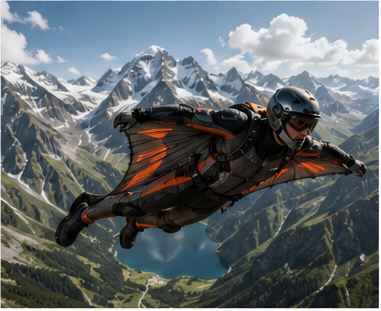
Wingsuit glide ratio has sat at roughly 3:1 for a decade — not because the physics ran out, but because the design methodology did. Nobody applied computational fluid dynamics to full-suit geometry or selected materials by aerodynamic function. We did, and the same reasoning applies to climbing, jumping and swimming.

Who this serves Wingsuit & BASE athletes Sport & competition climbing Stunt performers Parkour & freerunning Freedivers Adventure film crews STEM demonstration

Performance you can feel, from mechanisms you can read about.

Every claim on this site traces to a published mechanism and carries a technology readiness level. The shark riblet film reducing skin friction 8–10% is TRL 6 — it is already in Speedo Fastskin and Lufthansa Technik production. The humpback tubercle leading edge delaying stall from 22° to roughly 28° comes from Fish et al.'s wind tunnel work. Where a figure is a CFD-based design target awaiting wind tunnel validation rather than a measured result, we label it as such — including in our own marketing.

5.0–6.0:1
DragonSuit Apex glide ratio design target
2.8–3.0:1
Current best-in-class wingsuit
3–10×
JumpSuit jump height enhancement
$279
DragonSuit Scout entry price
The biology underneath

A wingsuit pilot and a peregrine falcon are solving the same problem at the same Reynolds number. The falcon has had sixty million years and a very unforgiving selection process. It spread its primary feathers to convert tip vortex rotation into forward thrust; the humpback grew bumps on its fins to hold attached flow past the angle where a smooth leading edge separates. We are not inspired by these animals. We are copying their homework, and checking it against the fluid dynamics.

PLATFORMS SERVING THIS MARKET

What we build for them.

Project A · Flight

DragonSuit Scout & Apex

Scout is the consumer entry SKU at $279–349: EVA foam ribs and a silk-screened TPU tubercle strip, targeting a 3.8–4.5:1 glide ratio over alpine terrain. Apex is the full five-layer stack for elite pilots — DiAPLEX shape-memory polymer ribs holding NACA 4412 geometry against the aerodynamic load that makes conventional suits billow, auxetic panels that camber themselves under pressure, and peregrine-derived tip slots that open passively where induced drag is highest.

Scout $279–349Apex $10K–18KPassive washout 3–5°No actuators
DragonSuit technical detail →
Project B · Climbing

GripSuit Scout, Gloss & Rough

Scout is a passive van der Waals pad for glass, polished stone and painted metal at $349–499 — the proof-of-concept SKU and a genuinely compelling STEM demonstration. Gloss adds electrostatic hybrid augmentation and self-cleaning for glass curtain wall. Rough swaps to the clingfish compliant lip and remora lamellae for concrete, masonry, brick and natural rock across Ra 50–800 µm — the surface class where gecko adhesion alone collapses.

Scout $349–499Ra 0.01–1000 µmDirectional releaseNo chalk, no anchors
GripSuit technical detail →
Project C · Ground

JumpSuit

Insect resilin returns stored elastic energy at 97% efficiency — better than rubber, better than carbon-fibre spring steel. The JumpSuit replicates it with carbon-fibre leaf-spring joints at ankle and knee, latched bistably so energy releases when the wearer wants it rather than bleeding away through the stride. For parkour, stunt work and trail running where a powered exosuit is neither affordable nor legal in competition.

97% returnBistable latchAnkle & kneeTRL 5
JumpSuit technical detail →
Project D · Water

AquaSuit

Boxfish ridge geometry generates self-correcting vortices under crossflow, giving a swimmer passive yaw stability with no fins and no active correction. A water-strider-derived superhydrophobic plastron traps an air layer against the surface, cutting drag an estimated 30–40%. Passive buoyancy control and breath-extension membrane work sit alongside for freediving applications.

30–40% drag reductionPassive yaw stabilityAir plastronTRL 3–5
AquaSuit technical detail →
What is validated and what is projected

The 5.0–6.0:1 DragonSuit glide ratio is a CFD-based design target derived from summing individually-published component contributions with a conservative 30% interaction discount applied. It has not yet been measured in a wind tunnel. Our full research proposal to UT Arlington states every assumption behind that number and proposes the experimental programme to test it — you can read the whole document.

The shark riblet layer at TRL 6 and the tubercle leading edge at TRL 4 rest on published, replicated results. The auxetic self-cambering panel and the peregrine tip slot sit at TRL 3–4 and are the components most likely to move once instrumented testing begins.

Pre-order interest, athlete partnership programmes and demonstration enquiries: getdragons@dragonworx.bio