Rovers and autonomous drones solve most lunar surface mobility. But every mobility programme has failure modes, and a crew member stranded several hundred metres from home base in a pressure suit not optimised for foot travel faces a consumable-limited emergency. We propose a passive augmentation layer that closes that gap at minimal mass, cost and integration complexity.
The lunar south pole presents rugged crater rims, steep slopes, low-angle lighting, permanently shadowed regions and 280 °C surface temperature swings. Our proposal attaches to the arm-torso junction and leg channels already present in most hard-shell upper torso designs — no pressure system integration, no power connection, no modification to the primary life support interface. A crew member dons or doffs it at the airlock, treating it as emergency traverse equipment analogous to a safety harness: present when needed, stowed otherwise. The stow package folds flat to roughly the size of a personal survival kit.
Nothing on the Moon evolved. That is exactly why the transfer analysis matters: every mechanism in the DragonWorx platform was selected by an environment with air, water and 1 g. Strip those away and some mechanisms keep working on pure material physics, some change function entirely, and some become dead mass. Knowing which is which — before anyone builds hardware — is the whole contribution.
The JumpSuit leaf-spring architecture is the highest-value transfer to the lunar surface because its mechanism has no dependence on atmosphere. At one-sixth gravity the same stored energy produces a dramatically longer ballistic arc. A crew member covers 600 m in roughly 15–20 assisted strides, arriving at the airlock within minutes rather than the 20–30 minutes an unaugmented EVA shuffle would take — a meaningful difference in a suit approaching consumable limits.
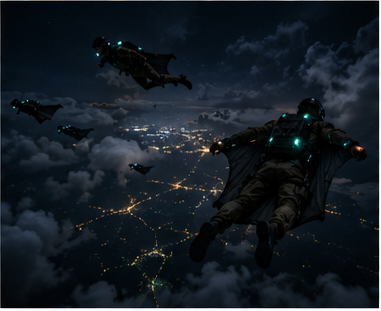
The DragonSuit wing generates no lift in vacuum — we state that plainly. What it does provide is attitude control and landing-posture preparation through the ballistic arc. Without it, a colonist achieves 40 m per bound with high positional error and real landing risk. With it, they achieve 40 m per bound with controllable attitude and a prepared landing. Over a kilometre of traverse, that shifts the technology from impressive stunt to viable transport mode.
The GripSuit rough-surface architecture is the strongest Mars candidate in the entire DragonWorx portfolio. Martian basalt surface chemistry is favourable to van der Waals adhesion, and reduced gravity improves the safety margin by roughly 2.5× relative to Earth climbing. For canyon wall survey, lava tube descent and crater rim access, it offers a mobility mode that requires neither anchors nor a powered winch.
Mass freed by deleting the aerodynamic-only layers goes to aerogel-composite thermal panels and radiation-shielding fabric. The regolith interface is its own engineering problem: electrostatically charged, ultra-fine, near-cohesionless dust defeats conventional boot design, and the compliant clingfish disc geometry manages it substantially better than added mass does.
Most concept work for off-world wearables shows a render and stops. This is the component-by-component verdict, including the four technologies we would delete from a lunar variant entirely.
| Technology | Earth function | Lunar / Martian verdict |
|---|---|---|
| Resilin leaf-spring joints JumpSuit | 97% elastic energy return at ankle and knee | Highest-value transfer. Works perfectly in vacuum. Delivers ~2–2.5× range gain over unassisted lunar movement; 35–45 m per bound; 15–20 km/h sustained bounding traverse. |
| SMP rib skeleton DragonSuit | Holds NACA 4412 wing geometry under aerodynamic load | Transfers with material substitution. DiAPLEX SMP fails at lunar shadow temperatures of −173 °C. Any planetary variant must use NiTi shape-memory alloy instead. |
| Wing membrane DragonSuit | Generates lift; 5–6:1 glide ratio | Function changes entirely. Zero aerodynamic lift in vacuum. Survives as a ballistic attitude-control and landing-preparation surface — which converts a dangerous leap into a navigable one. |
| Gecko + clingfish + remora stack GripSuit | Multi-surface dry adhesion at body weight | Highest-value Mars technology. Basalt surface chemistry favours van der Waals adhesion, and reduced gravity yields roughly a 2.5× safety-margin improvement for climbing. |
| Shark riblet film | 8–10% turbulent skin friction reduction | Delete. No atmosphere, no boundary layer, no benefit. Mass budget reallocated to thermal insulation. |
| Tubercle leading edge | Delays stall 22° → 28° | Delete. Stall is an aerodynamic phenomenon. Irrelevant in vacuum. |
| Auxetic cambering panel | Passive camber optimisation under dynamic pressure | Delete. Requires aerodynamic pressure to actuate. There is none. |
| Boot / regolith interface | — | New requirement. Regolith is electrostatically charged, ultra-fine and near-cohesionless. The clingfish compliant disc architecture manages it far better than added boot mass. |
This is a concept proposal, not a funded programme. It was submitted to the NASA Moon Base collaboration call as a response to the mobility and human surface operations categories. Nothing here has flown, and no component has been tested in a vacuum chamber or a lunar-gravity analogue.
A deeper proposal — the version we would submit on request — would add explicit trajectory mathematics, AxEMU joint interface geometry, a component-level mass breakdown, a full TRL matrix, and a proposed Phase I test protocol. What we have published so far is the physics-first analysis of which technologies transfer and which do not, including the four we would delete outright.
For the full lunar and Martian transfer analysis, trajectory modelling, or programme discussion: getdragons@dragonworx.bio