Project B · TRL 5 · Highest readiness
GripSuit Apex-M
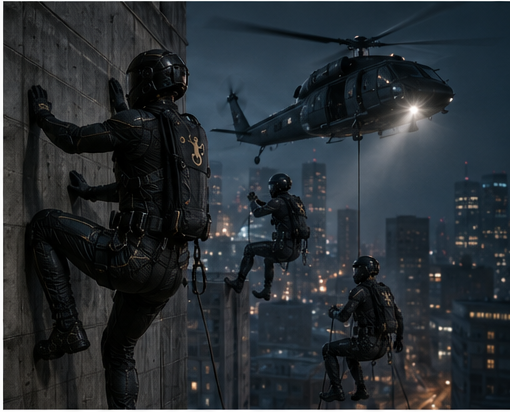
Four-mechanism adhesion stack in a zone-selective pad: gecko van der Waals nano-pillars for glass and polished stone, clingfish compliant disc lip for rough concrete and masonry, remora lamellar spinules that self-tighten under shear, and DOPA-mimetic mussel chemistry for submerged steel. Silent ascent of structures with no anchor points, no drilling, and no rope signature. CBRN-relevant access to contaminated structures.
Ra 0.01–1000 µmWet & drySilent releaseDARPA Z-Man validated
GripSuit technical detail →
Project A · Military SKU
DragonSuit Apex-M
Low-observable passive insertion platform. Five-layer composite stack — SMP rib skeleton holding NACA 4412 geometry under load, auxetic self-cambering panels, humpback tubercle leading edge, shark riblet film — with helicoidal CFRP armour, NIJ-rated padding and MOLLE integration over the full aerodynamic stack. Roughly twice the glide ratio and half the minimum deployment altitude of current military wingsuit options.
2× glide ratioStall delayed 22°→28°No powered component$28K–$45K
DragonSuit technical detail →
Project C · TRL 5
JumpSuit
Carbon-fibre leaf-spring exoskeletal joints at ankle and knee, storing and returning energy through a bistable snap-through latch modelled on insect resilin at 97% elastic return. Gets an operator over a wall, onto a roof, or across rubble without a ladder, a boost, or a power pack. Adds no electronics to a kit already carrying too many.
97% energy return3–10× jump heightZero powerPassive latch
JumpSuit technical detail →
TRL 5–6 · Most mature platform
ArmorSuit — helicoidal CFRP
Mantis shrimp fibre architecture applied to carbon composite: the same carbon fibre, stacked in a rotating helicoidal ply schedule rather than a conventional one. A crack that would run straight is forced into a spiral path, requiring roughly 70% more energy to propagate. Runs on existing automated fibre placement machines — no new factory.
+70% fracture energyExisting AFP toolingMantis shrimp dactyl club
TRL 3 · Sensing
SensorSuit & ElectraSuit
Passive electroreception modelled on the platypus bill: 64–256 graphene electrodes across helmet and collar detecting oscillating electric fields from living organisms, electronics and structural voids at roughly two metres. It emits nothing, so it cannot be detected in return. Direct search-and-rescue application locating casualties through rubble. Powered by PVDF harvesting from the wearer's own gait.
~2 m passive detectionNo emitted signalPVDF self-poweredSAR through rubble
TRL 2–3 · Force protection
SentinelSuit
Beta-carboline compounds in the shell panels fluoresce under 365 nm UV, giving passive friend-or-foe identification with no power, no emitter and no electronic signature — borrowed directly from scorpion cuticle. Microfluidic channels running through the garment deliver haemostatic sealant automatically at a puncture site.
Passive IFF365 nm UVMicrofluidic wound sealantScorpion cuticle