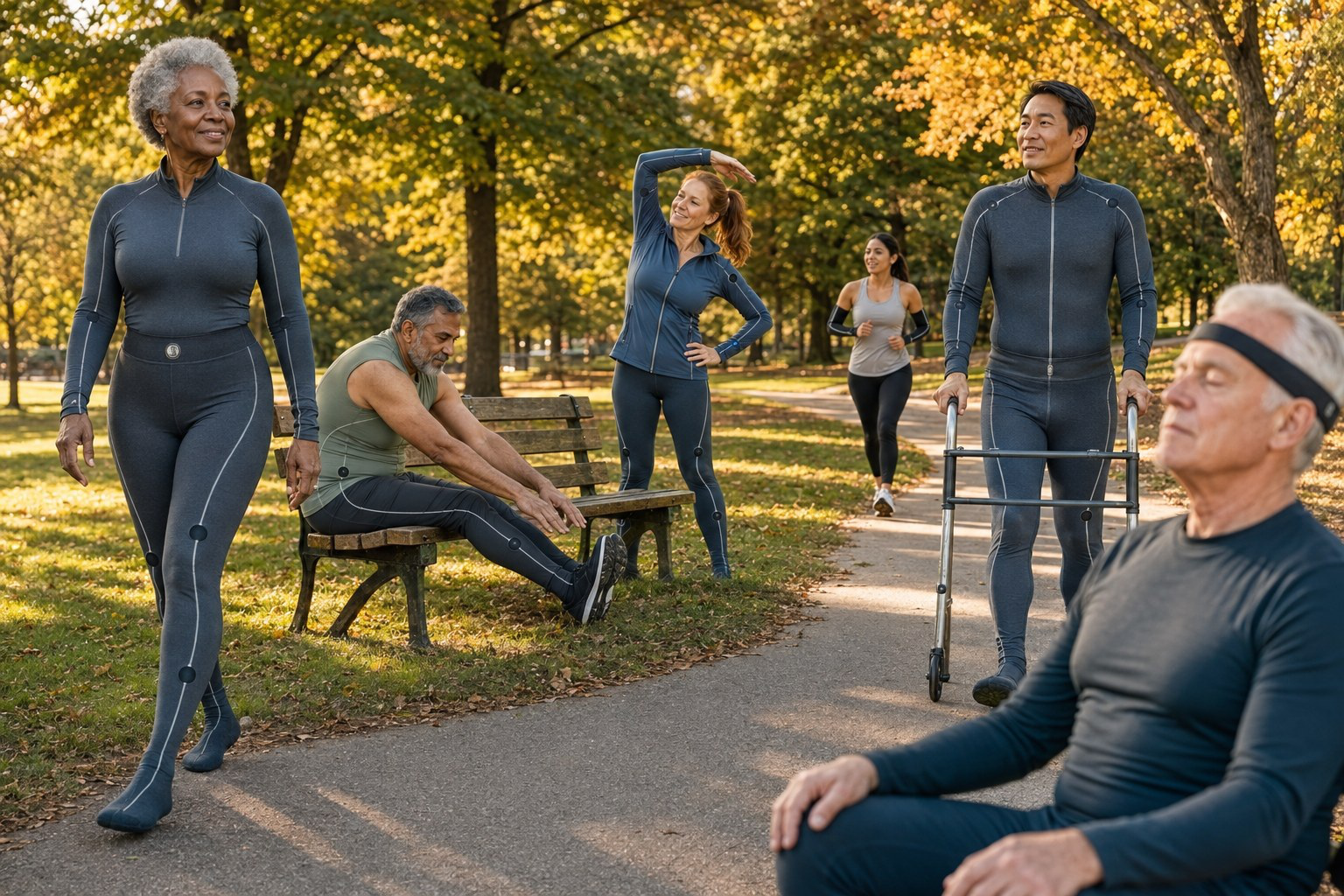
Either the garment is passive but dumb — a compression stocking, a knee brace, a heating pad — or it is smart but dependent, requiring daily charging, clinical supervision, and a five-figure price tag. AMRS harvests electrical energy from the wearer's own gait and delivers therapy continuously, all day, with no battery and no compliance burden.
The largest failure mode in therapeutic wearables is not efficacy — it is that patients stop charging them. Every electrostimulation wearable on the market today, from TENS units to NMES sleeves, requires a battery and therefore requires a habit. AMRS eliminates that dependency entirely: triboelectric nanogenerators woven into high-flexion zones convert gait friction into usable current, so the garment delivers baseline therapy at zero charge state. Four capabilities that do not currently coexist in any single product — self-powered output, dual-modality stimulation on one substrate, anatomically-routed current delivery, and passive mechanical assist — combine in a 2.4 mm textile stack no thicker than ordinary performance compression wear.
On the word “meridian”: set the energetic claim aside entirely — it is not load-bearing for this design. Langevin and Yandow found that roughly 80% of classical acupoints and 50% of mapped meridian segments coincide with intermuscular or intramuscular connective-tissue planes. The term here refers to a historically-derived empirical map of the fascial network's low-impedance conduction pathways. The map predates the instrumentation that validated it. We use it because it is the most complete such map in existence, not because we endorse the metaphysics originally attached to it.
Micro-pyramidal tribo-surfaces at the knee, ankle and hip convert flexion into current. Output reaches 35 µA short-circuit at sub-5 Hz mechanical input — precisely the frequency band of normal human gait, and comfortably within transcutaneous safety envelopes. A controlled human trial of full-textile body-coupled stimulation socks produced a 21.47% increase in calf-raise frequency and 6.25% reduction in muscle fatigue with no external power whatsoever.
Silver-coated yarn embroidered along fascial-plane trajectories rather than diffusing isotropically from an electrode. Tissue impedance along these connective-tissue planes measures significantly lower than along parallel non-meridian paths — 70.4 Ω versus 75.0 Ω — and the difference correlates with the presence of loose connective tissue visible on ultrasound.
Linear resonant actuators, 14 mm diameter and under 8 g, deliver sinusoidal vibration across the 40–120 Hz therapeutic band directly into soft tissue, driving fascial mechanotransduction. Clinical literature spans Parkinson's rigidity, MS spasticity, fibromyalgia pain and stroke motor recovery. The FDA has determined vibroacoustic devices substantially equivalent and exempt from premarket notification.
Nacre-analog elastic laminates — alternating rigid platelet and compliant polymer layers modelled on abalone shell brick-and-mortar architecture — store energy at knee flexion and return roughly 70% at toe-off. Variable-stiffness polymers derived from sea cucumber mutable connective tissue stiffen under stance-phase load and relax during swing. A fraction of a powered exosuit's assist, at 1/100th the cost and 1/10th the mass.
A coin-cell BLE module at the lower back provides zone selection and closed-loop impedance sensing on electrode contact quality, drawing under 1 mW idle. With no app connected the module stays dormant and the garment operates passively — the intelligence is optional, the therapy is not.
MIT's Tsai and Picower work established that 40 Hz sensory stimulation attenuates amyloid load and modifies microglial state in murine Alzheimer's models, now advancing through human trials. Independently, 40 Hz is the probe frequency at which meridian wave-propagation asymmetry was demonstrated, and it sits inside the 25–50 Hz band associated with bone density and tissue healing. That convergence was found, not designed — and it sets the AMRS default operating frequency.
Each SKU covers a different body region and a different population. Price tiers sit where no incumbent currently operates — above a compression stocking, below a powered exosuit.
| SKU | Coverage | Primary clinical targets | Price |
|---|---|---|---|
| LW-1 Tights | Waist to toe | Sarcopenia, stroke gait rehabilitation, Parkinson's, DVT, lymphoedema, fall-risk reduction | $480–650 |
| TW-1 Torso | Trunk, sleeveless | Chronic low back pain, fibromyalgia, osteoporosis, post-surgical recovery, scoliosis | $420–580 |
| AC-1 Arm Cuff | Wrist to shoulder | Post-stroke hand rehabilitation, carpal tunnel, rheumatoid arthritis, chemotherapy-induced neuropathy | $280–380 |
| JK-1 Jacket | Waist up, plus arms | Adhesive capsulitis, MS upper-limb spasticity, Parkinson's rigidity, post-mastectomy lymphoedema | $680–950 |
| FS-1 Full Suit | Head to toe | Incomplete spinal cord injury, advanced MS, full-body stroke rehabilitation, elderly independence maintenance | $1,200–1,800 |
| HD-1 Crown | Head and cervical | Alzheimer's and dementia (40 Hz gamma), essential and Parkinsonian tremor, migraine, tinnitus, TBI, vagal dysregulation | $390–550 |
Consumer on-ramp SKUs — MeridianSock ($49), MeridianSleeve ($129–189), ResonancePatch ($89), AcuDrape Pro ($449) — are modelled separately and serve primarily as ecosystem acquisition and real-world-evidence generation channels.
No head-to-head trial of vibroacoustic-at-acupoints versus electroacupuncture exists. The combination is mechanistically well-motivated — distinct receptor systems, distinct tissue targets — but the synergy is inferred, not demonstrated. That is a named Phase-1 study objective.
Several recent trials show no superiority of electroacupuncture over sham for chronic pain. We regard this as informative rather than disqualifying: it suggests point-specificity may matter less than tissue-plane targeting for electrical modalities, which is consistent with our impedance-routing rationale.
The 7.8 Hz meridian resonance finding is pilot-scale and unreplicated. It is treated as a hypothesis to test, not a design foundation. AMRS therapeutic claims rest on the 40 Hz and body-coupled stimulation literature, both of which are substantially more mature.
Passive mechanical assist is real but modest. Nacre-laminate energy return will not restore gait to someone who cannot generate it. AMRS is explicitly indicated for partial mobility loss — the population between “compression stocking” and “powered exosuit,” which is where nearly all of the volume is.
The full AMRS technical brief — evidence base, material stack, regulatory strategy, go-to-market sequence and engineering figures — is available below. For clinical partnership or investor discussion, contact getdragons@dragonworx.bio